
Moving to Houston, Texas: Your Complete 2026 Relocation Guide
Moving to Houston in 2026 comes down to three decisions: which job center to live near, whether to rent first or buy at a $330,000 median home price (HAR, August 2026, Greater Houston single-family), and the flood check on any address you shortlist.
Updated
Is Houston a good place to relocate to in 2026?
Yes. It comes down to three decisions: which job center to live near (the Texas Medical Center, the Energy Corridor, Downtown, or NASA in Clear Lake), rent first or buy at the $330,000 median home price (HAR, August 2026, Greater Houston single-family), and the FEMA flood zone and flood history of any address you shortlist. The financial reality: 0% state income tax, property tax of about 2.1% combined (all taxing units, before exemptions, for a City of Houston address in Houston ISD; Harris County Tax Office, hctax.net), and a $1,193 citywide average one-bedroom rent (RentCafe, September 2026). With 27 Fortune 500 headquarters (2026 list) across energy, healthcare, and aerospace, the metro added 126,720 residents between July 2024 and July 2025, the largest numeric gain of any U.S. metro (U.S. Census Bureau, Vintage 2025).
- 0% state income tax — keep thousands more of your salary
- Median home: $330K metro (HAR, August 2026, Greater Houston single-family)
- Food scene: 13,000 restaurants representing cuisine from more than 70 countries and American regions (Visit Houston)
- 27 Fortune 500 HQs (2026 list) across energy, healthcare, aerospace & tech
Found this useful?Add RelocateMeTX as a preferred source on Google
Before you choose, price the move: the Houston cost of living page sets rent, taxes and utilities against the U.S. average. Need somewhere to stay while you test commutes? A short furnished stay lets you try a job center before you sign for a year: compare furnished apartments in Houston.
Houston is the fourth-largest city in the United States and home to the most Fortune 500 energy headquarters of any city, per the Greater Houston Partnership — but reducing it to oil and gas misses the bigger picture. The Greater Houston metro is home to the Texas Medical Center (what TMC calls the world's largest medical complex), NASA's Johnson Space Center, the Houston Ship Channel (the nation's largest port for waterborne tonnage, per Port Houston), and 27 Fortune 500 headquarters (2026 list). With a metro population of 7,904,627 (U.S. Census Bureau, July 2025) that the City of Houston calls the most ethnically diverse in the nation, Houston offers an unusual combination of global-city amenities and Sun Belt affordability. This guide covers everything you need to make a confident move to Houston in 2026 — from flood zones to school districts to the electricity market.
New to Houston? Live Furnished While You House-Hunt.
Houston Corporate Housing offers furnished apartments for long and short term stays, with no utility, membership or parking fees (Houston Corporate Housing's own published terms).
Sponsored: RelocateMeTX is affiliated with Houston Corporate Housing.
Explore Your Move
Everything you need, organized and actionable.
Houston at a Glance
Real numbers. Real advantages.
Metro Population
Median Home Price
State Income Tax
Sales Tax Rate
Job Growth (BLS, Aug 2026 vs Aug 2025)
Why People Are Moving to Houston in 2026

Houston's growth story is driven by a rare convergence of factors: an enormous and diversified economy, no state income tax, a low cost of living relative to its size, and a genuinely international character that most American cities cannot match. The metro added 126,720 residents between July 2024 and July 2025, the largest numeric gain of any U.S. metro (U.S. Census Bureau, Vintage 2025).
An Economy Built on More Than Energy
Yes, Houston is home to the most Fortune 500 energy headquarters of any city, per the Greater Houston Partnership. ExxonMobil, Chevron (corporate headquarters relocation to Houston announced August 2024), ConocoPhillips, Phillips 66, and Halliburton all operate major presences here. But the economy has diversified substantially over the past two decades. The Texas Medical Center is home to about 106,000 employees. NASA's Johnson Space Center anchors a growing aerospace corridor. Port Houston calls the Houston Ship Channel the nation's largest port for waterborne tonnage. And the city's tech sector, while smaller than Austin's, has grown rapidly as companies like Hewlett Packard Enterprise have relocated their headquarters here.
27 Fortune 500 Headquarters
Houston is home to 27 Fortune 500 companies on the 2026 list, making it one of the top corporate headquarters cities in the nation. These span energy, healthcare, retail, technology, and industrial sectors — providing a breadth of career opportunities that insulates the market from single-sector downturns.
Houston is home to 27 Fortune 500 companies and the Texas Medical Center — about 106,000 employees
No State Income Tax
Like the rest of Texas, Houston residents pay zero state income tax. Combined with lower housing costs, the effective income advantage of living in Houston is substantial. Use our cost-of-living calculator to model your specific tax savings.
Unmatched Diversity
The City of Houston calls Greater Houston the most ethnically diverse metropolitan area in the United States, and at least 145 languages are spoken by city residents. The diversity shows up in the food — from Viet-Cajun crawfish in Midtown to Salvadoran pupusas on the East Side to Nigerian suya in Alief. The international community is a genuine asset for global professionals and their families, with established cultural organizations, consulates, and bilingual services.
Affordability at Scale
Houston's city median sale price ($349,769) is below Dallas ($448,703) and Austin ($549,636) (Redfin, three months to Aug 2026); across Greater Houston, the median single-family price was $330,000 (HAR, August 2026). Rental prices are similarly favorable: the average one-bedroom rent in the city is approximately $1,193 per month (RentCafe, September 2026). If you are relocating and need time to explore the market, our furnished housing directory lists furnished apartments across the metro. Ready to start planning? See our complete Houston moving guide.
Houston vs. Other Major Texas Metros
| Metric | Houston | Dallas | Austin | San Antonio |
|---|---|---|---|---|
| Metro Population July 2025, Census |
7.9M | 8.48M | 2.62M | 2.81M |
| Fortune 500 HQs metro, Fortune 500 2026 list |
27 | 24 | 3 | 2 |
| Median Home Price city median sale price, Redfin, three months to Aug 2026 |
$349,769 | $448,703 | $549,636 | $264,825 |
| Average 1BR Rent RentCafe, Sept 2026 |
$1,193 | $1,417 | $1,427 | $1,081 |
| State Income Tax | 0% | 0% | 0% | 0% |
| Job Growth (Aug 2026 vs Aug 2025, BLS, not seasonally adjusted) | 1.3% | 1.0% | 1.2% | 0.5% |
Cost of Living in Houston: What You'll Actually Pay
Houston is cheaper than Dallas and Austin for housing. The absence of a state income tax amplifies the affordability advantage. Here is how the main costs compare.
Property tax: one Houston address as a baseline
Texas has no state income tax, so property taxes fund local services and schools. The row below is one baseline, a City of Houston address in Houston ISD:
| County | Combined Rate (pre-exemption) | Annual Tax on $330K Home |
|---|---|---|
| Harris County | ~2.1% | ~$6,930 |
These combined rates are representative, not official. No Texas county publishes a single combined property tax rate. Your bill is the sum of independently governed taxing units — county, school district, city, hospital, college, flood control and any MUD — so the total is address-dependent. Harris County's own 2025 levy is $0.380960 per $100; the remainder comes from the other units at your specific address. Treat the figure as a typical residential total, not the rate you will be billed. Source: Harris County Tax Office adopted rates.
Houston vs. Dallas vs. Austin — Cost Comparison
| Category | Houston | Dallas | Austin |
|---|---|---|---|
| Median Home Price (city median sale price, Redfin, three months to Aug 2026) | $349,769 | $448,703 | $549,636 |
| Average 1BR Rent (RentCafe, Sept 2026) | $1,193 | $1,417 | $1,427 |
| Avg. Property Tax Rate (combined, pre-exemption) | ~2.1% | ~2.23% | ~2.05% |
| Sales Tax Rate | 8.25% | 8.25% | 8.25% |
The property tax rates in this table are representative, not official. No Texas county publishes a single combined rate — the bill is the sum of independently governed taxing units, so the total depends on your address, not just your county. Harris County's own 2025 levy is $0.380960 per $100; the rest of the ~2.1% (for a City of Houston address in Houston ISD) comes from the school district, city and other units. Source: Harris County Tax Office adopted rates.
Key takeaway: Houston is the most affordable of the three major Texas metros for housing. Combined property tax rates are close across the three. The trade-off is higher electricity bills driven by air-conditioning demand (Houston is hotter and more humid than Dallas), and the potential cost of flood insurance in certain areas. Use our cost-of-living calculator to model your specific budget.
State income tax on your salary, bonuses, and retirement income in Texas
Featured Neighborhoods
Hand-picked areas popular with relocators


Latest Houston Articles
Houston Realities New Residents Don't Expect
Houston has genuine advantages, but also a set of realities that most guides skip. Here are five of them.
Flood Zones: FEMA Zone AE vs. Zone X Is a Big Financial Difference
Houston floods. Harvey (2017) dropped 36 to 48 inches of rain across the Houston metro (National Hurricane Center). Zone AE properties (high flood risk) require federal flood insurance if you have a federally backed mortgage. Zone X properties face much lower risk but can still flood. Always check the FEMA Flood Map Service Center (msc.fema.gov) for any address before making an offer. Ask specifically whether the home flooded during Harvey, Tax Day Flood (2016), or Memorial Day Flood (2015).
MUD Taxes: What They Are and How to Check Before Buying
Municipal Utility Districts (MUDs) are special taxing districts in suburban Houston that fund water, sewer, and drainage infrastructure. On top of your county and city property taxes, a MUD levy in Harris County ran from 0.03% to 1.72% of taxable value in 2025 (median 0.54%; Harris County Tax Office), up to about $5,160 a year on a $300K home. Not all suburban Houston areas have MUDs, but many do. Check the Texas Commission on Environmental Quality (TCEQ) MUD database before making an offer. Your realtor should disclose this; if they don't, ask directly.
ERCOT Electricity: Deregulated Market Requires Active Shopping
Most of Houston is served by deregulated electricity (unlike Austin). You must choose your retail electric provider. Visit PowerToChoose.org (official Texas PUC site) to compare plans. Avoid variable-rate plans. The 2021 Uri storm showed what can happen to customers on wholesale-indexed plans during a grid failure.
Hurricane Season: June Through November, Every Year
Atlantic hurricane season runs June 1–November 30. Houston's Gulf Coast location means tropical storms and hurricanes are a real annual consideration, not a once-in-a-generation event. Build a basic preparedness kit: 3–7 days of water and food, battery radio, phone chargers, cash, and copies of key documents. If you're buying a home, ask about wind mitigation features and verify your homeowner's policy includes wind coverage (it's separate from flood in Texas).
Commute Reality: I-10, Loop 610, and Beltway 8 at 8am
Houston's freeways are wide but brutally congested, and a drive that is quick at midday can take far longer at rush hour. Before committing to a neighborhood, drive your actual commute route during morning rush.
Don't Rush Your Houston Home Search.
Corporate housing for long and short term stays. Explore the Medical Center, Energy Corridor, or The Woodlands before committing to a lease.
Sponsored: RelocateMeTX is affiliated with Houston Corporate Housing.
Best Houston Neighborhoods and Suburbs by Lifestyle

Houston is enormous — the city limits alone cover 665 square miles, and the metro stretches across nine counties. Choosing where to live is the most consequential decision you will make when relocating. Unlike Dallas, which sprawls primarily northward, Houston's neighborhoods fan out in every direction from a dense urban core called the Inner Loop (defined by Interstate 610). Explore all options in our full neighborhood directory, then use our moving guide to plan your transition. Here is how to think about it by lifestyle.
Inner Loop — Urban Living
The Inner Loop is where Houston's walkable, culturally rich neighborhoods cluster. It is where you will find the best restaurants, nightlife, museums, and street-level energy. The trade-off is higher rents, smaller homes, and traffic congestion.
- Montrose: An eclectic inner-loop neighborhood. Bungalows and townhomes mix with art galleries, vintage shops, and some of the best dining in the city. Walkable by Houston standards, with an arts and nightlife scene.
- The Heights: Victorian-era homes, tree-lined streets, and a thriving local business scene along 19th Street and White Oak. Family-friendly but with strong nightlife on the edges. One of Houston's most desirable addresses.
- Midtown: Dense, walkable, and close to both Downtown and the Museum District. Primarily townhomes and apartments. Strong bar and restaurant scene. Close to jobs Downtown and in the Medical Center.
- EaDo (East Downtown): One of Houston's fastest-changing neighborhoods. Former warehouse district now filling with breweries, art spaces, new apartment buildings, and easy access to Daikin Park and Shell Energy Stadium. The closest thing Houston has to a Brooklyn-style revival.
- Rice Village / West University: Adjacent to Rice University, this area offers a college-town atmosphere with upscale shops and restaurants. West University Place is an independently incorporated city with its own police and excellent schools.
Family-Friendly Suburbs
Houston's suburbs offer top-rated school districts, master-planned communities, and significantly lower housing costs than the Inner Loop. The trade-off is longer commutes and a car-dependent lifestyle.
- Katy: A popular family suburb. Katy ISD is a TEA B-rated district (2025-26). Master-planned communities like Cinco Ranch, Cross Creek Ranch, and Elyson. West of Downtown on I-10.
- Sugar Land: Master-planned suburb in Fort Bend County. Fort Bend ISD is highly rated. Town Square offers walkable dining and shopping, and the area has an international grocery and restaurant scene. Southwest of Downtown.
- Pearland: Growing suburb south of Houston. Pearland ISD and Alvin ISD serve the area. Close to the Medical Center via SH-288. Popular with healthcare workers.
- League City: Located between Houston and Galveston along I-45. Clear Creek ISD is TEA B-rated (89/100, 2025-26) with multiple A-rated campuses including Clear Falls and Clear Lake High. Close to NASA Johnson Space Center and the Bay Area. Appeals to aerospace professionals and families who want proximity to the coast.
Young Professionals
- Washington Avenue Corridor: Bars, restaurants, and new-construction townhomes. Walking distance to Memorial Park. Popular with professionals in their late 20s and 30s.
- Downtown Houston: Rapidly growing residential population. High-rise living, easy access to sports venues, Theater District, and Discovery Green park. Minimal driving needed for daily life if you work Downtown.
Master-Planned Communities
- The Woodlands: A nationally recognized master-planned community north of Downtown. The Woodlands Waterway, Market Street shopping, and the Cynthia Woods Mitchell Pavilion. Conroe ISD. Increasingly a corporate corridor — HP Enterprise, Chevron Phillips, and Anadarko (now Occidental) have offices here.
- Cypress: Fast-growing community northwest of Houston. Cypress-Fairbanks ISD (Cy-Fair) is one of the largest districts in Texas. Master-planned neighborhoods like Bridgeland and Towne Lake. Popular with families priced out of Katy.
Browse all Houston neighborhoods in our neighborhood directory, or use the commute calculator to find the best location relative to your workplace.
Houston's city median sale price ($349,769) is below Dallas ($448,703) and Austin ($549,636) (Redfin, three months to Aug 2026)
Source: Redfin, city median sale prices, three months to Aug 2026. Greater Houston metro single-family median: $330,000 (HAR, August 2026)
Plan Your Move with Real Numbers
Not guesswork. Interactive calculators for cost of living, rent vs buy analysis, salary comparison, and moving costs.
Houston Job Market: Top Employers and Energy Corridor

Houston's economy rests on four main pillars: energy, healthcare, aerospace, and port-driven logistics. While energy remains the headline industry, the Texas Medical Center alone would make Houston a major employment center even if oil disappeared tomorrow. Here is a breakdown of the key sectors and where the jobs are.
Energy
Houston is home to the most Fortune 500 energy headquarters of any city, per the Greater Houston Partnership. The energy corridor along I-10 West (between Beltway 8 and SH-6) concentrates thousands of energy-related offices. Major employers include:
- ExxonMobil — Spring campus north of Houston.
- Chevron — Corporate headquarters relocation to Houston announced August 2024 (Chevron).
- ConocoPhillips — Headquartered in the Energy Corridor.
- Phillips 66 — Headquarters in Westchase. Refining, midstream, and chemicals.
- Halliburton — Oilfield services giant headquartered in Houston.
- SLB (Schlumberger) — Relocated U.S. operations to Houston. Major employer in oilfield technology.
- Baker Hughes — Oilfield services and digital solutions. Headquartered in Houston.
Healthcare — Texas Medical Center
The Texas Medical Center (TMC) is what TMC calls the world's largest medical complex, spanning more than 1,345 acres (about 2.1 square miles) and home to about 106,000 employees (TMC). Key institutions include:
- MD Anderson Cancer Center — Ranked No. 1 for cancer care in U.S. News & World Report's 2026-27 Best Hospitals, its 12th year in a row.
- Houston Methodist — Eight hospitals, consistently ranked among the nation's best.
- Memorial Hermann — Not-for-profit health system.
- Texas Children's Hospital — Pediatric hospital system based in the medical center.
- Baylor College of Medicine — Medical school and research institution.
Aerospace — NASA & Beyond
The Johnson Space Center in Clear Lake is the home of NASA's astronaut training and mission control. The surrounding Bay Area has become a corridor for aerospace and defense employers:
- NASA Johnson Space Center — 12,000+ civil servants and contractors (NASA.gov center profile, 2026).
- Boeing — Major contractor for the International Space Station and Space Launch System.
- Lockheed Martin — Orion spacecraft production and other defense programs.
- Axiom Space — Commercial space station company headquartered in Houston.
- Intuitive Machines — Lunar lander company, publicly traded, based in Houston.
Finance, Technology & Professional Services
- JPMorgan Chase — Thousands of employees across multiple Houston campuses.
- Deloitte — Major professional services presence serving energy and healthcare clients.
- Hewlett Packard Enterprise — Relocated corporate headquarters to Spring, TX in 2022.
- Insperity — HR and business services company headquartered in Kingwood.
- Waste Management — Fortune 500 company headquartered in Houston.
Key Employment Corridors
- Energy Corridor (I-10 West): Between Beltway 8 and SH-6. Home to ConocoPhillips, BP, Shell Woodcreek campus, and hundreds of oilfield services firms. Read our Energy Corridor neighborhood guide.
- Texas Medical Center: South of Downtown, accessible via METRORail Red Line. About 106,000 employees in a 2.1-square-mile campus, which TMC calls the world's largest medical complex.
- Downtown Houston: Major banking, legal, and professional services hub. JPMorgan Chase, Deloitte, EY, and most large law firms. The Theater District, Discovery Green, and a growing residential population.
- The Woodlands / Spring: ExxonMobil Spring campus, HP Enterprise, and Chevron Phillips Chemical. An increasingly important corporate corridor north of Downtown.
- NASA / Clear Lake: Johnson Space Center, Boeing, Lockheed Martin, and numerous aerospace startups. Located southeast of Downtown along I-45.
Relocation Packages
Corporate relocation packages vary by employer, role level, and whether you own or rent. Packages can include temporary housing, household goods shipment, home-sale assistance, and cost-of-living adjustments for international transfers. Healthcare systems like Methodist and Memorial Hermann also offer structured relocation support for recruited physicians and nurses. Ask your recruiter for specifics — and use our relocation cost calculator to estimate out-of-pocket expenses.
Houston is home to 4,200+ energy-related firms (Greater Houston Partnership) and the Texas Medical Center
Energy, healthcare, aerospace (NASA JSC), and international trade drive the economy
Houston Schools, Healthcare, and Daily Life Basics
Ratings are the official Texas Education Agency A–F accountability grade, not a Niche composite. Check any district at txschools.gov.

School quality drives neighborhood choice for families moving to Houston, and the differences between districts are significant. The Houston metro is served by dozens of independent school districts, each with its own tax rate, academic culture, and performance record. Here are the districts that consistently rank at the top.
Top-Ranked School Districts
Key Takeaways for Families
- Katy ISD is one of the region's largest districts. It has a B TEA accountability rating (2025-26). The district has opened new campuses nearly every year to keep pace with enrollment growth.
- Fort Bend ISD covers Sugar Land, Missouri City and Richmond. It holds a B TEA accountability rating (2025-26).
- Clear Creek ISD benefits from the NASA connection. Located in the Clear Lake / League City area, CCISD has a strong STEM culture influenced by proximity to Johnson Space Center. The district offers specialized aerospace and engineering programs that leverage local industry partnerships.
- Houston ISD (HISD) requires homework. HISD is enormous and varied. District-wide metrics are misleading. Campus-level quality ranges from nationally ranked magnet schools — like DeBakey High School for Health Professions, Carnegie Vanguard, and the High School for the Performing and Visual Arts — to underperforming campuses. If you are willing to research and apply to magnet programs, HISD can provide an outstanding public education within city limits.
- Friendswood ISD is a hidden gem. Friendswood offers a small-town school experience with strong academics. The trade-off is limited enrollment capacity and a narrow attendance zone.
Use our full school district guide for detailed campus-by-campus breakdowns, enrollment procedures, and boundary maps.
| District | TEA Rating | Enrollment | Key Strength | Location |
|---|---|---|---|---|
| Katy ISD | B | 96,000+ | One of the Largest Districts | Katy / Cinco Ranch / Elyson |
| Friendswood ISD | A | — | Small-District Excellence | Friendswood |
| Clear Creek ISD | B | — | STEM & Aerospace Focus | League City / Clear Lake / Webster |
| Fort Bend ISD | B | — | Fort Bend County Coverage | Sugar Land / Missouri City / Richmond |
| Cypress-Fairbanks ISD | B | — | Scale & Variety | Cypress / Jersey Village |
| Spring Branch ISD | B | — | Inner-Loop Access | Memorial / Spring Branch |
| Tomball ISD | A | — | TEA A district | Tomball / Pinehurst |
| Houston ISD | B | — | Magnet Programs | Houston city limits |
TEA rating is the official Texas Education Agency A–F accountability grade (2025-26). Check any district at txschools.gov.
Friendswood ISD, Pearland ISD and Tomball ISD hold an official TEA A for 2025-26 (txschools.gov)
School district quality is the first question most relocating families ask about Texas
Transportation in Houston — Highways, METRORail, and the Car Reality

Houston is a car-dependent city — that is the blunt reality. The nine-county metro covers 9,444 square miles, and the highway system is the backbone of daily transportation. However, METRORail has expanded, park-and-ride options exist for commuters, and a handful of neighborhoods allow car-light living for the right person.
METRORail Light Rail
METRO operates three light rail lines:
- Red Line: The original line, running from Fannin South through Stadium Park/Astrodome, the Texas Medical Center, Hermann Park/Rice University, Museum District, Midtown, Downtown, and north to Northline (METRO).
- Green Line: Runs east from Downtown through EaDo to Magnolia Park/Southeast.
- Purple Line: Runs southeast from Downtown through the Third Ward to Palm Center.
If you live and work along the Red Line corridor — for example, Midtown to the Medical Center, or Downtown to the Museum District — you can make rail transit work for your daily commute. Outside this corridor, transit coverage is limited.
Park-and-Ride System
METRO operates park-and-ride lots across the metro, with express bus service to Downtown and the Medical Center. This is a popular option for suburban commuters from Katy, The Woodlands, Kingwood, and Clear Lake. Park-and-ride buses offer Wi-Fi, comfortable seating, and bypass freeway congestion on HOV/HOT lanes.
Key Highways
- I-10 (Katy Freeway): East-west artery from Downtown to Katy and beyond. It is very wide, yet it congests severely during rush hour.
- I-45 (Gulf Freeway / North Freeway): North-south spine connecting The Woodlands to Downtown to Galveston. The most heavily traveled highway in Houston.
- I-610 (The Loop): The 38-mile inner loop that defines Houston's urban core. Living "inside the Loop" is a meaningful distinction in Houston culture and real estate.
- US-290 (Northwest Freeway): Connects Downtown to Cypress and the northwest suburbs. Recently widened but still congested during peak hours.
- Beltway 8 (Sam Houston Tollway): The outer loop. Toll road that circles the city.
- SH-288: South corridor connecting Downtown to Pearland. Recently expanded with managed toll lanes.
- SH-99 (Grand Parkway): Outermost loop, still under construction in segments. Connects Katy, The Woodlands, and League City via the far suburbs.
Airports
- George Bush Intercontinental Airport (IAH): Houston's primary international airport, located north of Downtown. Major hub for United Airlines. Connected to Downtown by METRO Route 500 Downtown Direct.
- William P. Hobby Airport (HOU): Located southeast of Downtown. A Southwest Airlines base. Primarily domestic routes with some international service to Latin America and the Caribbean. More convenient for travelers living inside or south of the Loop.
The bottom line: you will need a car in Houston. Budget for a car payment, insurance, gas, and tolls. If you work in the Medical Center or Downtown, living inside the Loop or using the park-and-ride system can meaningfully reduce your driving time and stress. For a deeper look at commute options, see our Houston transportation guide.
Houston rush hour on I-10 and I-45 can stretch a drive well past its midday time
METRO rail covers limited areas — car ownership is essential.
Houston Weather, Humidity & Flooding — The Honest Guide
See live Houston weather forecast & climate data →

Houston's climate is the single most common concern for prospective transplants — and for good reason. The city sits on the Gulf Coastal Plain. Humidity is high, summers are long, and flooding is a real risk that must factor into your housing decisions. Here is the season-by-season reality.
- Summer (June – September): This is the main event. Normal highs run 90.4°F to 94.9°F from June to September (NOAA 1991-2020, Bush Intercontinental), and humidity makes it feel hotter. Unlike Dallas, Houston's heat is wet — the combination of heat and humidity is relentless from late May through mid-October. Your electricity bill will be your largest utility cost as air conditioning runs nearly 24/7. Indoor life dominates: malls, restaurants, and air-conditioned gyms become social centers.
- Fall (October – November): The best time of year, and it arrives suddenly. By mid-October, humidity drops, temperatures reach the 70s and 80s, and outdoor life returns. Houston's parks, patios, and greenways come alive. November offers some of the most pleasant weather in the country.
- Winter (December – February): Mild and variable. Normal highs run 63.8°F to 67.8°F (NOAA 1991-2020), with occasional cold fronts dropping into the 30s for a few days. Snow is exceedingly rare. You will own a light jacket, not a winter coat. The downside is persistent gray, overcast skies in January and February that newcomers from sunnier climates find dreary.
- Spring (March – May): Warm and increasingly humid, with temperatures climbing from the 70s in March to the 90s by late May. Severe thunderstorms are common from March through May, sometimes producing hail and tornadoes. The real spring risk is flooding from heavy rainfall events.
Hurricane Season
Atlantic hurricane season runs from June 1 through November 30. Houston is directly vulnerable to Gulf of Mexico storms. Hurricane Harvey in August 2017 dropped 36 to 48 inches of rain on the Houston metro and flooded at least 160,000 structures in Harris and Galveston counties, and more than 300,000 across southeastern Texas (National Hurricane Center). While Harvey was an extreme event, tropical storms and hurricanes affect the Houston area every few years. If you live in Houston, you need a hurricane preparedness plan: emergency supplies, evacuation routes, important documents in waterproof storage, and a clear understanding of your flood risk.
Flooding — The Critical Factor
Flooding is the single most important risk factor to evaluate when choosing where to live in Houston. The metro's flat terrain, clay soil (which does not absorb water well), and extensive impervious surface coverage mean that heavy rainfall events can cause flash flooding even outside designated flood zones. Key facts:
- FEMA flood maps identify 100-year and 500-year floodplains. Properties in a 100-year floodplain require flood insurance if you have a federally backed mortgage.
- Many properties that flooded during Harvey were outside designated flood zones. FEMA maps are a starting point, not the final word.
- Harris County Flood Control District maintains the most detailed local flood data. Check their interactive map before making any housing decision.
- Flood insurance costs depend on location, elevation, and flood history; get a quote before you sign.
- Sellers are required to disclose known flooding history, but disclosure laws have gaps. Always ask explicitly and check independent flood-risk databases.
Read our Houston flood zone guide before signing a lease or making an offer on a home. This is not optional — it is the most important research you will do in your Houston relocation.
Best Months to Move
October through April offer the most comfortable conditions for moving. October and November are ideal — low humidity, pleasant temperatures, and outside of peak hurricane season. Avoid moving in July or August if possible; loading a truck in August heat and humidity is genuinely dangerous without frequent breaks and hydration.
Your Houston Relocation Checklist
The move involves the same Texas-specific administrative tasks as any in-state relocation, plus a few Houston-specific considerations around flooding and hurricane preparedness. Here are the critical steps, roughly in order of urgency.
- Set up electricity before you arrive. Texas has a deregulated electricity market — your home will not have power unless you actively choose a Retail Electric Provider (REP). Visit PowerToChoose.org to compare plans. Houston is served by CenterPoint Energy (transmission and delivery), but you choose your REP for the generation charge. Lock in a fixed-rate plan for 12 to 24 months for budget predictability. Do this at least one week before your move-in date. Expect higher summer electric bills due to heavy air-conditioning demand.
- Research flood risk for your property. Before signing a lease or closing on a home, check flood zone status on the Harris County Flood Control District map and FEMA's flood map service. Ask the landlord or seller directly about flooding history. If your property is in a FEMA high-risk flood zone and you have a federally backed mortgage, flood insurance is required; either way, factor it into your budget.
- Register your vehicle within 30 days. Texas requires vehicle registration within 30 days of establishing residency. If you are in an emissions-testing county (Harris, Fort Bend, Brazoria, Galveston, Montgomery), you will need an emissions test (up to $18.50, per DPS). A $7.50 inspection replacement fee is added to your registration. Then visit your county tax office with your out-of-state title, proof of insurance, and inspection report.
- Get your Texas driver's license within 90 days. Visit a DPS (Department of Public Safety) office. Bring your current license, Social Security card, two proofs of Texas residency (lease, utility bill), and proof of U.S. citizenship or lawful status. Book your appointment online — walk-ins at Houston-area DPS offices can involve long waits.
- Update vehicle insurance to Texas minimums. Texas requires 30/60/25 minimum liability coverage. Many states have lower minimums, so your existing policy may need adjustment. Given Houston traffic and flood risk, consider comprehensive coverage that includes flood damage — standard auto policies typically exclude flood.
- Register to vote. Texas voter registration must be completed at least 30 days before an election. Register at the Harris County Elections Administrator office or download the form from the Texas Secretary of State website.
- Build a hurricane preparedness kit. This is Houston-specific and non-negotiable. Your kit should include: 3 days of water (1 gallon per person per day), non-perishable food, flashlights and batteries, a battery-powered weather radio, first-aid supplies, important documents in a waterproof container, a full tank of gas in your car during hurricane season, and a plan for where to go if evacuation is ordered. The City of Houston publishes an annual hurricane preparedness guide each May.
- Set up water, gas, and internet. Water is handled by the City of Houston for most areas inside city limits, or by your local MUD (Municipal Utility District) in suburban areas. Natural gas is provided by CenterPoint Energy (not deregulated — you have one provider). Internet options vary by address — Comcast Xfinity, AT&T Fiber, and Ezee Fiber (fiber; formerly Tachus) are the most common providers.
For a printable version with links to every form and office, see our complete Houston moving checklist. We also maintain a utilities setup guide with provider comparisons and average costs by neighborhood.
-
Research neighborhoods & schools
8-12 weeks before move
-
Set up electricity (deregulated areas)
3-5 business days lead time needed
-
Transfer driver's license
Within 90 days of establishing residency
-
File homestead exemption
Apply before May 1; it removes $140,000 from your school-district taxable value
-
Register vehicle (+ emissions test if required)
Within 30 days — safety inspections eliminated Jan 2025
Frequently Asked Questions About Moving to Houston
Is Houston prone to flooding?
How does the Houston job market compare to Dallas?
What is the cost of living in Houston vs. Austin?
Which Houston neighborhoods are best for families?
How does the electricity market work in Houston?
Is Houston safe?
What is the commute like in Houston?
How is Houston's healthcare system?
What are the best areas to live near the Texas Medical Center?
Does Houston have good public transportation?
Houston Relocation Resources
Free guides, tools, and media to help plan your move to Texas.
🎧 Listen: Audio Guide
Moving to Texas: The Complete Guide
🎬 Watch: Video Overview
Why Texas? The Data-Driven Case
A visual breakdown of Texas advantages for relocators.
📊 Infographic
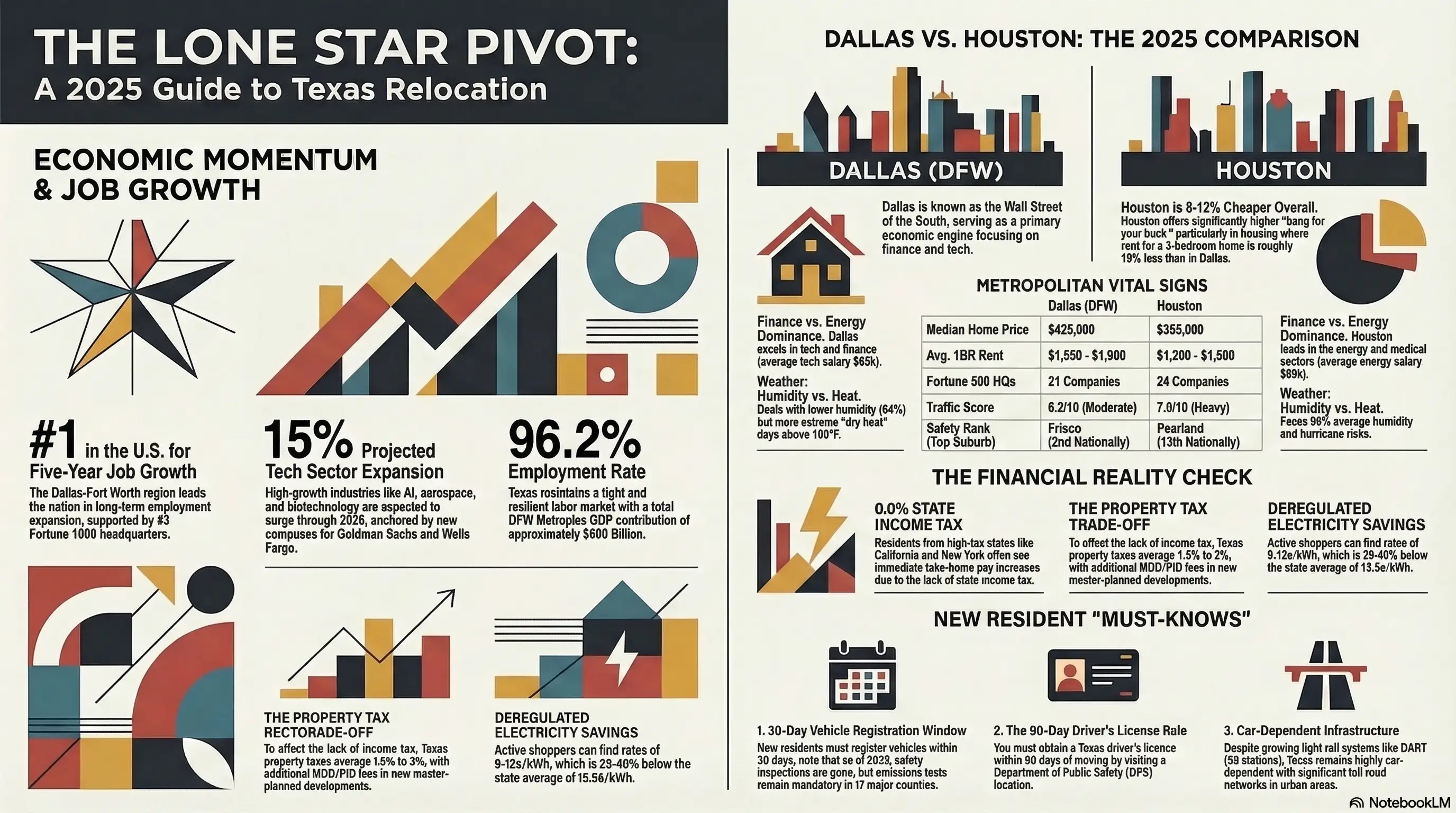
Texas Relocation At A Glance
Key stats on tax savings, cost of living, job growth, and top cities.
📥 Downloadable Resources
Test Your Texas Knowledge
Take our interactive quiz to see how much you know about relocating to Texas.
Also considering Dallas?
Compare neighborhoods, cost of living, and employers in our Dallas relocation guide.
Traveling to Houston for medical care?
We've mapped every free, low-cost, and furnished lodging option near Houston's Texas Medical Center — including Hope Lodge, Halo House, medical-rate hotels, and furnished apartments.
See Houston medical lodging guide →Local Service Providers
Browse movers, locators, and cleaners by category
Need a Furnished Apartment in Houston?
Move-in ready furnished apartments. Perfect for corporate relocators, travel nurses, and anyone starting fresh in Houston.
Our Properties — RelocateMeTX is affiliated with Houston Corporate Housing
More Houston Relocation Guides
Houston Neighborhoods
Compare 15+ neighborhoods by cost, commute & vibe
Cost of Living Calculator
Compare Houston costs vs. your current city
Houston City Guide
Food, nightlife, sports, outdoors & more
Houston Schools Guide
Top-rated districts and school rankings
Houston Employers
Energy, healthcare & aerospace job market
Houston vs Dallas
Side-by-side metro comparison
Houston vs Austin
Side-by-side metro comparison
Houston vs Denver
Jobs, cost of living & lifestyle comparison
All Houston Comparisons
Houston vs Dallas, Austin, San Antonio and Denver, side by side
Houston vs San Antonio
Texas metros compared for relocators
Best for Aerospace Workers
Top neighborhoods near NASA JSC & aerospace employers
Best for Energy Workers
Neighborhoods near the Energy Corridor & refineries
Living Near the Texas Medical Center
TMC commute times, rents and neighborhood picks for hospital staff
Best for Young Professionals
Walkable neighborhoods with real nightlife for young professionals
Inner-Loop Picks for Early-Career Renters
Montrose, Midtown, Heights, EaDo and Rice Military ranked by Walk Score, rent and commute
Inside the Loop
12 inner-loop Houston neighborhoods compared
Katy vs Sugar Land vs Pearland
Schools, safety, flood risk, commute and taxes across the three suburbs
First 30 Days in Houston
New-resident checklist: license, registration, electricity, flood insurance
Best for Families
Suburb picks with top schools and family amenities
Best for Remote Workers
Internet speed, home-office space, and coworking access
Best for Flood Safety
Houston areas with the best flood record
Houston Medical Lodging
Patient housing near MD Anderson, TCH & Methodist
Texas Income Tax Guide
No state income tax — see your savings
Moving to Texas Guide
Statewide relocation guide — costs, timeline & first steps
Sources & References (21)
The figures on this page come from the sources listed below. Check the dates before you rely on them.
- [1]U.S. Census Bureau — Population Estimates— Metro population and migration data
- [2]Bureau of Labor Statistics— Employment, wages, and CPI data
- [3]Fortune 500 (2026 List)— Corporate headquarters by metro
- [4]HAR and Redfin— Greater Houston single-family median (HAR, Aug 2026); city median sale prices (Redfin, three months to Aug 2026)
- [5]Texas Education Agency — TXschools.gov— School district A–F accountability ratings (official search tool)
- [6]FEMA Flood Map Service Center— Flood zone designations
- [7]Texas Comptroller of Public Accounts — Property Tax Rates— Property tax rates by county
- [8]Walk Score— Walk, transit, and bike scores
- [9]RentCafe— Average one-bedroom rents, September 2026
- [10]NOAA NCEI 1991–2020 Climate Normals— Monthly normals, Bush Intercontinental (IAH)
- [11]National Hurricane Center— Tropical Cyclone Report: Hurricane Harvey
- [12]Visit Houston— Restaurant count
- [13]Greater Houston Partnership— Energy headquarters and firm counts
- [14]Port Houston— Houston Ship Channel tonnage
- [15]Texas Medical Center— Campus size and employees
- [16]NASA Johnson Space Center— Johnson Space Center workforce (12,000+)
- [17]U.S. News & World Report Best Hospitals 2026-27 (MD Anderson release)— MD Anderson No. 1 for cancer care, 12th year in a row
- [18]METRO (Houston)— METRORail lines and Red Line stations
- [19]Zillow Home Value Index— Typical home values by neighborhood (Bellaire vs West University), August 2026
- [20]Harris County Tax Office— Adopted 2025 tax rates, including MUDs
- [21]FBI Crime Data Explorer— 2025 agency violent-crime data
Get the Houston Insider Newsletter
Neighborhood insights and relocation updates for Houston. The newsletter is still in the works, so subscribe now and you'll be on the first send.
No spam. Unsubscribe anytime. We respect your privacy.
If you add us, Google is more likely to show RelocateMeTX in your Top Stories, and can mark our links as preferred in your AI Overviews and AI Mode. It only affects your own results.