
The Houston metro added 126,720 residents between July 2024 and July 2025, more than any other U.S. metro by raw count. Families drive a disproportionate share of that growth: Houston’s birth rate of 12.3 per 1,000 residents is the highest among major U.S. metros. Those families are choosing Houston over Austin, Denver, and coastal California for reasons that show up in the data, not just in the marketing brochures. This article breaks down every dimension that matters to a relocating family: schools, housing costs, jobs, childcare, flood risk, and the honest downsides nobody puts in the chamber-of-commerce pitch.
The Numbers Behind Houston’s Family Boom
The Houston metro reached 7.9 million residents as of July 2025, according to U.S. Census Bureau estimates. Between July 2024 and July 2025 the metro added 126,720 residents — the largest raw gain of any U.S. metro that year (Census Vintage 2025).
That birth rate signals something beyond population count. Cities with high birth rates invest more in pediatric healthcare, school construction, and family-oriented infrastructure. Houston’s suburban counties (Fort Bend, Montgomery, Galveston) are adding schools, hospitals, and parks faster than most Sun Belt metros. Fulshear, in Fort Bend County, has tripled in population since 2020, making it the fastest-growing U.S. city with 50,000+ residents according to Census Bureau data.
The migration pattern matters too. Families are arriving from California, New York, and Illinois, bringing coastal salaries into a market with no state income tax and median homes under $350K. For a full overview, check our Houston city guide.
What $330K Buys a Family in Houston
Houston’s single-family median price was $330,000 in August 2026, according to HAR market data (Greater Houston single-family). On a same-basis city comparison (city median sale price, Redfin, Aug 2026), Houston’s $349,769 sits about 36% below Austin ($549,636) and about 43% below Denver ($619,090). A four-bedroom home in Katy or Cypress runs $300,000 to $400,000 with a two-car garage, a backyard, and access to top-rated school districts.
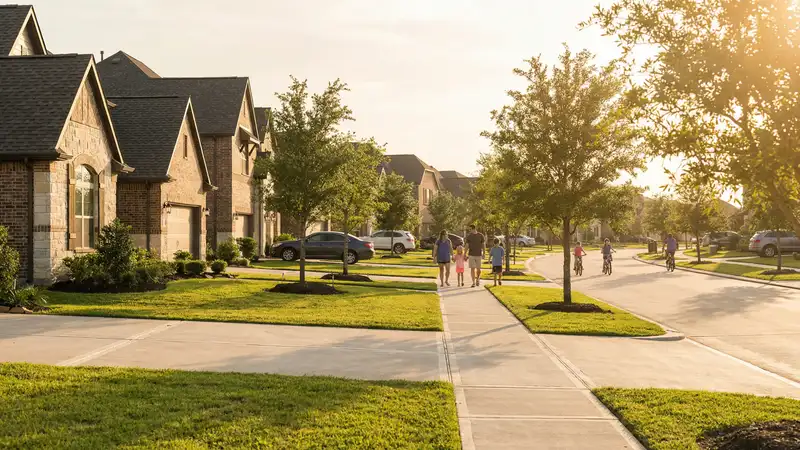
The rental market is even more striking. Houston’s apartment vacancy rate hit 11.6% in early 2026, the most tenant-friendly level in two decades. See our Houston housing overview for current rent data by neighborhood. Over 50,000 new apartment units have been delivered since 2023, and landlords are offering concessions. Citywide average rent holds steady at roughly $1,193/month, 27% below the national average.
| Metro | Median Home Price | Avg Rent (1BR) | Cost of Living Index |
|---|---|---|---|
| Houston | $330,000 | $1,193/mo | 94.1 (5.9% below avg) |
| Austin | $412,000 | $1,450/mo | 103.2 (3.2% above avg) |
| Denver | $550,000+ | $1,600/mo | 108.5 (8.5% above avg) |
| National Average | ~$420,000 | $1,620/mo | 100.0 |
Sources: HAR (August 2026, Greater Houston single-family), Unlock MLS (August 2026, Austin-Round Rock-San Marcos metro), Redfin, C2ER Cost of Living Index (Q1 2026). The Denver figure is a metro-level estimate.
Houston’s cost of living index sits at 94.1, meaning a family of four spends about 5.9% less than the national average across housing, groceries, healthcare, and utilities. The Economic Policy Institute estimates a Houston family of four needs $95,093/year to live comfortably. Browse all neighborhoods by price in our Houston neighborhoods guide.
5 School Districts That Justify the Property Tax
Katy ISD earned an 88 out of 100 from the Texas Education Agency in 2025, the highest score among the state’s 10 largest school districts. The district serves roughly 96,000 students across 74 schools, and it shows up on national rankings year after year. Families who say “we moved to Katy for the schools” aren’t exaggerating.
Pearland ISD received a straight A rating from TEA in 2025-26. Clear Creek ISD earned a B rating at 89/100, Klein ISD earned a B rating as well, and Cy-Fair ISD scored 86/100. These four districts ring the Houston metro’s western and southern suburbs, covering most of the neighborhoods families actually move to.
The biggest surprise is HISD itself. Houston ISD jumped from a C to a B (85) in 2025-26, and the number of F-rated campuses dropped from 56 to zero. TEA Commissioner Mike Morath called it “the largest academic turnaround in the history of the United States.” Black students are 3.5 times more likely to attend an A or B-rated campus than they were two years ago. The turnaround is real, even if the reputation hasn’t caught up yet.
That property tax rate matters more once you look at what it buys in each district. See our family neighborhoods guide for school-by-school breakdowns.
A Job Market That Keeps Both Parents Employed
Houston’s healthcare sector will add 14,000 jobs in 2026 alone, according to the Greater Houston Partnership. That accounts for 45% of the metro’s projected 30,900 new jobs. Total healthcare employment across the metro already exceeds 400,400 workers.
The Texas Medical Center is the anchor. With about 106,000 employees across 60+ institutions, it processes more than 10 million patient encounters per year. Houston Methodist landed on Forbes’ Best Large Employers list for 2026, and major systems are building new campuses in Cypress, Pearland, and Lake Houston to keep pace with suburban population growth.
Energy still matters. ExxonMobil’s Spring campus, Shell’s Woodcreek campus, and Chevron’s downtown tower employ tens of thousands of engineers, geologists, and corporate staff. NASA’s Johnson Space Center anchors a growing aerospace sector around Clear Lake. The Port of Houston, busiest in the country by foreign tonnage, drives logistics jobs across the eastern suburbs.
For a dual-income family, Houston’s advantage is diversity of employers. If one spouse works in healthcare and the other in energy or tech, both industries are hiring. If one industry slows down, the other keeps paychecks coming. Start planning your timeline with our Houston moving guide.
The Hidden Costs That Catch Families Off Guard
Texas has no state income tax. On a $120,000 household income, that saves roughly $5,000-8,000 compared to California or New York. But property taxes offset some of that savings, and three other costs surprise most transplants.
Property taxes run 1.8-2.2% combined (before exemptions) across Houston-area counties, depending on your jurisdiction. On a $330,000 home, that works out to $5,940-$7,260 per year. The good news: Texas raised the homestead exemption to $140,000 in 2025 (SB 4), which comes off your assessed value for the school-district portion of the bill only; county, city, and MUD taxes use their own, smaller exemptions.
Flood insurance is the cost that catches newcomers the hardest. The 322,000 Houston-area homes in FEMA flood zones face annual premiums ranging from $1,000 to $2,338 depending on zone and risk factors. FEMA’s Risk Rating 2.0 system can raise your premium up to 18% annually until it reaches the “true risk” rate. Check your specific address at msc.fema.gov before you make an offer on any Houston home.
Childcare runs $1,040/month for infant center-based care in Houston, according to Care.com. For a family with an infant and a toddler, that adds up to roughly $21,600 per year, consuming 27% of the median household income in Texas. Over half of Texas counties qualify as “childcare deserts” where kids outnumber licensed slots 3-to-1.
Car insurance in Houston averages $215/month for full coverage (Insurify 2026), the highest rate among Texas cities. Budget accordingly.
Where Houston Families Actually Live: 6 Suburbs Compared
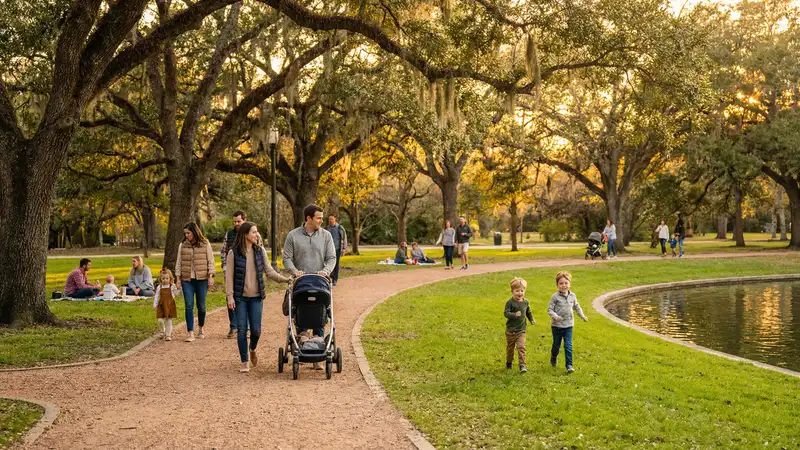
Five suburbs dominate the family relocation conversation, plus one inside-the-loop option for families who refuse to commute.
| Suburb | School District (TEA Score) | Median Home | Commute to Downtown | Best For |
|---|---|---|---|---|
| Katy | Katy ISD (B/88) | $340K | 30-40 min | Families prioritizing schools |
| Sugar Land | Fort Bend ISD | $350K-$500K | 30-40 min | Low crime, polished suburbs |
| The Woodlands | Conroe ISD | $420K | 40-55 min | Master-planned, corporate relocations |
| Cypress | Cy-Fair ISD (B/86) | $330K | 35-45 min | Best value for new construction |
| Pearland | Pearland ISD (A) | $350K | 25-35 min | Medical Center commuters |
| West University Place | HISD (Bellaire HS feeder) | $1M+ | 10-15 min | Walkability, top schools, inside the loop |
Katy is the default answer for families, and for good reason. Katy ISD’s 88/100 TEA score, paired with median homes around $340K, makes the math work for most dual-income households. New construction in Cinco Ranch and Cross Creek Ranch gives you a dedicated home office and a backyard. Not for you if: you work downtown and hate a 30-40 minute commute each way.
Sugar Land draws families who want low crime rates and a polished suburban feel. Fort Bend County’s diverse population and strong schools make it a top pick for transplants from coastal cities. Not for you if: your budget is under $350K or you want nightlife options.
The Woodlands is the master-planned community that corporations relocate executives to. Conroe ISD is solid, the town center has retail and restaurants, and ExxonMobil’s Spring campus is 10 minutes away. Not for you if: you work south of I-10, because the 55-minute commute to the Medical Center will wear you down.
Cypress is the value play. Slightly cheaper than Katy, with Cy-Fair ISD’s strong B/86 rating and newer developments at Bridgeland and Towne Lake. Not for you if: you want walkable retail or nightlife.
Pearland climbs the ranking fast, thanks to its A-rated school district and shorter commute to the Texas Medical Center. Healthcare professionals flock here. Not for you if: you work north of I-10.
West University Place is the inside-the-loop exception. Homes start above $1M, but you get walkability, Bellaire High School as your feeder campus, and a 10-minute commute to the Medical Center. Not for you if: your budget is under $900K or you need a large lot.
If you need a short-term furnished apartment in Houston while you tour neighborhoods and finalize your school district decision, corporate housing keeps your family settled while you search. See all options in our safest neighborhoods list.
What Weekends Look Like With Kids in Houston
Houston’s Museum District packs 19 museums, galleries, and cultural centers into a few square miles. Space Center Houston (NASA Johnson Space Center’s visitor center) draws over a million visitors per year. The Houston Zoo in Hermann Park houses 6,000+ animals and offers free admission on the first Tuesday of every month.
Children’s Museum Houston opens free every Thursday from 5-8 p.m. as of early 2026. The Museum of Natural Science runs free Tuesdays from 5-8 p.m. A family of four can fill an entire month of weekends without paying a single admission fee, just by timing their visits.
Hermann Park itself has a miniature train, pedal boats, a Japanese garden, and enough stroller-friendly paths to burn out a toddler. Discovery Green downtown has splash pads. Buffalo Bayou Park runs 160 acres of trails along the bayou. Galveston’s beaches sit 50 minutes south on I-45 for Saturday mornings when the kids need sand between their toes.
Check out our full family activities guide for seasonal events and free admission schedules.
The Honest Downsides Nobody Puts in the Brochure
Houston is hot. Five months of the year (May through September) push 90°F or higher, and the humidity makes 95°F feel like 110°F. Your electricity bill will spike to $200-250/month in summer. Kids adapt faster than adults, but plan on indoor activities from 11 a.m. to 4 p.m. during July and August.
Flooding is real. Hurricane Harvey dropped 60 inches of rain in 2017, and flood risk hasn’t disappeared. The 322,000 homes in FEMA flood zones are concentrated in specific areas. You can avoid most flood risk by choosing newer developments with proper drainage (Katy, Cinco Ranch, Bridgeland) and checking your exact address on FEMA’s map before signing anything.
Houston sprawls. An hour-long commute from The Woodlands to the Galleria is normal during rush hour. Public transit exists (METRO buses and light rail) but covers a fraction of the metro. You will need two cars. Toll roads (Hardy, Westpark, Beltway 8) cost $5-15 per day depending on your route.
Mosquitoes are aggressive from April through October. No zoning means your neighbor can open a business next to your house. These aren’t dealbreakers, but they’re the things transplants from Denver or Portland wish someone had told them.
For the full weather picture, read our Houston weather guide.
Frequently Asked Questions
Is Houston safe for families in 2026?
Houston’s overall crime rate exceeds the national average, but safety varies dramatically by neighborhood. The suburbs families move to (Katy, Sugar Land, Pearland, The Woodlands) have crime rates well below both the city and national averages. West University Place has one of the lowest crime rates in the country. Focus on the specific suburb, not the metro-wide stat.
What is the best Houston suburb for families with young kids?
Katy is the most common recommendation for school quality and home value. Pearland offers the best combination of schools (A-rated by TEA) and a shorter commute to the Texas Medical Center. For new construction at the best price, Cypress edges both out. Sugar Land is the pick if low crime and polished suburban amenities matter most.
How much does a family of four need to earn to live comfortably in Houston?
The Economic Policy Institute estimates $95,093 per year for a family of four in Houston. That figure assumes $1,899/month for housing, $1,100-1,400/month for groceries, and $1,040/month for one child in infant daycare. Dual-income households earning $120K+ can live comfortably in most suburbs and save meaningfully.
Are Houston public schools any good?
Yes, especially in the suburbs. Your school quality depends entirely on which district your address falls in. Katy, Pearland, Klein, and Clear Creek are the strongest performers. HISD is improving fast but still carries a mixed reputation. Before you buy, verify the exact school your address feeds into at TEA’s TXSchools.gov portal, because district boundaries don’t always follow neighborhood lines.
Does Houston flood a lot?
Parts of Houston flood, but the risk is highly location-specific. Newer master-planned communities engineered their drainage after Harvey’s lessons. The biggest mistake transplants make is skipping the FEMA flood map check before signing a contract. Pull your address at msc.fema.gov, budget $1,000-$2,338/year for insurance if you’re in a flood zone, and ask your inspector about the property’s Harvey history.
Is Houston worth moving to from California or New York?
For families earning $100K+, the math strongly favors Houston. No state income tax saves $5,000-8,000/year depending on your California or New York bracket. A home that costs $330K in Katy would run $700K+ in comparable California suburbs. The tradeoff: you lose walkability, temperate weather, and coastal access. You gain square footage, school quality, and a significantly lower monthly burn rate.
Houston earns its spot as the strongest family relocation city in Texas for 2026, and it’s not because of any single factor. The combination of $330K median homes, A and B-rated school districts, about 106,000 Texas Medical Center jobs, and a cost of living 6% below the national average creates a package that Austin, Denver, and the coasts can’t match. The heat, the sprawl, and the flood zones are real tradeoffs. Budget for them honestly, pick the right suburb, and check your flood zone before signing. For most dual-income families earning $100K+, Katy or Pearland will be the right answer. Start with our Houston neighborhoods guide to narrow your search by school district, commute, and price.