Inside the Loop: Houston's 12 Best Neighborhoods Within I-610 (2026)
12 inner-loop Houston neighborhoods compared by walkability, dining, nightlife, crime rates, flood risk, and HISD school context. The definitive guide to living inside I-610.
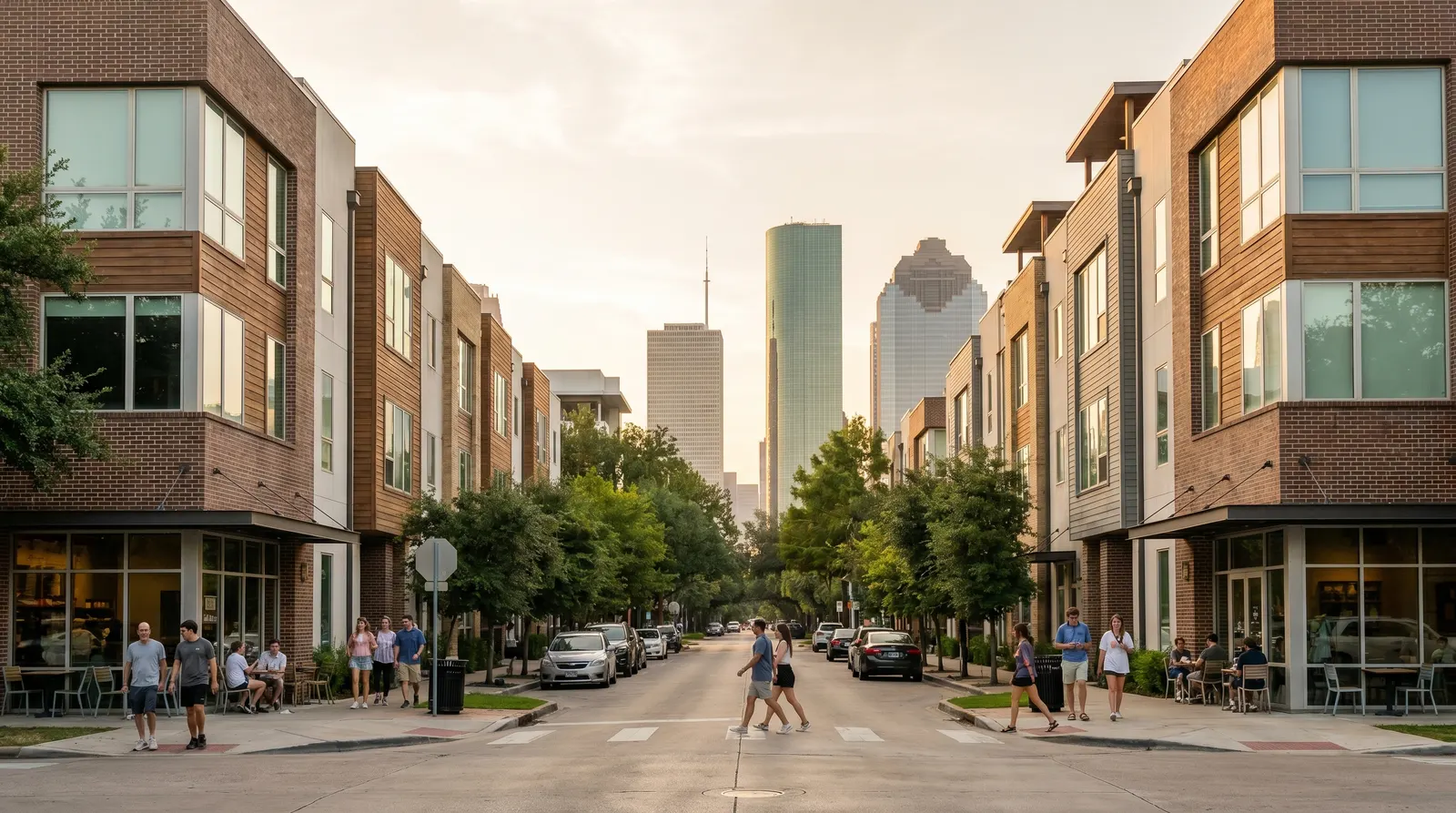
"Inside the Loop" is Houston's shorthand for neighborhoods within the I-610 freeway loop — the 38-mile highway that encircles the city's urban core. This is where Houston feels least like the car-dependent sprawl city of its reputation. Inside the loop, you will find walkable streets lined with restaurants and coffee shops, cultural institutions rivaling any city in America, biking trails along Buffalo Bayou and White Oak, and commute times measured in minutes rather than hours.
The trade-offs are real and worth understanding before you commit. Inner-loop homes cost more per square foot ($180-$565) than suburban equivalents ($135-$220). Every inner-loop neighborhood falls within Houston ISD, which has been under Texas Education Agency state management since June 2023 — a source of instability for families who prioritize school district predictability. You will get less square footage for your dollar, and crime rates in some neighborhoods run higher than suburban averages. Parking can be competitive on weekends in Montrose and Midtown. Lot sizes are smaller, and new-construction townhomes have largely replaced the single-family bungalows that once defined these streets.
But here is what you gain: no MUD taxes (saving 0.5-1.5% of your home's value annually), dramatically shorter commutes (10-20 minutes to Downtown, TMC, or the Galleria versus 35-60 from the suburbs), walkable access to dining and nightlife that ranks among the best in the South, and a lifestyle that does not require getting in a car for every errand. Inner-loop Houston is where transplants from walkable cities — New York, Chicago, D.C., Portland — tend to feel most at home. If you value culture, convenience, and community over square footage and school district rankings, the inner loop is likely your answer.
This guide compares all 12 inner-loop neighborhoods across walkability, rental prices, home values, crime rates, flood risk, and lifestyle fit. For the full 25-neighborhood analysis including suburbs, see our comprehensive Houston neighborhoods guide.
Inner Loop Neighborhood Comparison Table
All 12 inner-loop neighborhoods ranked by Walk Score. Rents and home prices reflect 2026 medians. Crime rates are violent crimes per 1,000 residents.
| Neighborhood | Walk Score | 1BR Rent | Home Price | Crime (Violent/1K) | Flood Risk | Vibe |
|---|---|---|---|---|---|---|
| Montrose | 8.7 | 1650 | $675K | 4.1 | Low | Eclectic / arts / dining |
| Midtown | 8.6 | 1800 | $380K | 5.8 | Low | Nightlife / transit |
| West U | 8.5 | 2100 | $1.65M | 0.8 | Low | Family / safety |
| Museum District | 7.9 | 1950 | $780K | 2.8 | Low-Mod | Culture / TMC |
| Rice Military | 7.6 | 1900 | $550K | 3.5 | Low-Mod | Restaurants / trails |
| The Heights | 7.5 | 1750 | $695K | 3.2 | Low | Historic charm |
| EaDo | 7.2 | 1650 | $440K | 6.2 | Low | Breweries / gentrifying |
| Third Ward | 6.5 | 1200 | $280K | 7.8 | Low | Budget / UH area |
| Timbergrove | 5.5 | 1450 | $450K | 2.9 | Moderate | Heights-adjacent |
| Bellaire | 5.2 | 1600 | $750K | 2.1 | Mod-High | Independent city |
| Garden Oaks | 5.0 | 1500 | $450K | 2.5 | Low | Quiet / family |
| River Oaks | 4.4 | 2600 | $2.6M+ | 1.2 | Low-Mod | Ultra-luxury |
Data from Walk Score, HAR, HPD, and FEMA. Prices reflect Q1 2026 medians. Walk Scores displayed as X/10 for readability (multiply by 10 for official 0-100 scale).
What "Inside the Loop" Actually Means
Interstate 610 forms a rough 38-mile oval around central Houston. It was completed in 1975, and over the four decades since, the highway has become far more than a transportation corridor — it is a cultural boundary that shapes identity, property values, and lifestyle expectations.
Houstonians who live inside I-610 call themselves "Loopers." The term carries an implicit set of values: walkability matters, dining culture is central to social life, chain restaurants are viewed skeptically, commute time is measured in minutes, and the suburban master-planned lifestyle is something to be avoided. This is not universal — plenty of inner-loop residents drive SUVs and eat at Chili's — but the cultural current is real and influences everything from real estate marketing to restaurant openings.
The property value impact is measurable. Homes immediately inside the loop command a 15-25% premium over comparable properties just outside it. A 1,800-square-foot renovated bungalow in the Heights (inside the loop) will cost $695K; a similar home in Garden Oaks (also inside, but barely) runs $450K; and an equivalent in Spring Branch (just outside the loop) drops to $350K. The loop creates an invisible price wall. For relocators, understanding this dynamic is essential: the lifestyle upgrade of living inside the loop comes at a real, quantifiable cost — and whether that cost is justified depends entirely on what you value.
Inner Loop Lifestyle Clusters
Not all inner-loop neighborhoods are alike. They cluster into four distinct lifestyle profiles, and knowing which cluster fits you will narrow your search dramatically.
Walkable & Social: Montrose, Midtown, EaDo
These three neighborhoods form Houston's urban energy center. Montrose (Walk Score 87) is the cultural heartbeat — galleries, the Menil Collection, Rothko Chapel, Houston's best independent restaurants (Underbelly Hospitality, Hugo's, Uchi), vintage shops, and the center of the LGBTQ+ community. It is Houston's most complete neighborhood: you can live, eat, shop, drink, and access world-class art without a car. Midtown (Walk Score 86) is the nightlife and transit hub — METRORail Red Line runs through its center, the bar scene is Houston's densest, and townhome prices ($425K median) are the lowest of any walkable inner-loop neighborhood. It skews younger and louder than Montrose. EaDo (East Downtown, Walk Score 72) is the gentrifying frontier — former warehouses converted to breweries (8th Wonder, True Anomaly), art studios, and loft-style townhomes. Prices remain relatively affordable ($440K), but crime is higher (6.2 violent/1K) and the neighborhood is still filling in. If you are a young professional who moved to Houston from Austin, Portland, or Brooklyn, this cluster is where you will feel the most immediate recognition.
Character & Community: The Heights, Garden Oaks, Timbergrove
This cluster is where Houston's inner loop feels residential rather than urban. The Heights (Walk Score 75) is the anchor — tree-lined streets of restored Victorian bungalows, the Saturday Heights Farmers Market, the 19th Street shopping corridor, and White Oak Bayou trail running through its center. The Heights proved Houston could do walkable neighborhood life, and property values reflect it ($695K median). Garden Oaks (Walk Score 50) offers a quieter alternative: mid-century ranch homes on generous lots under mature live oak canopy, the Garden Oaks Montessori magnet school, and an active civic club that organizes block parties and community gardens — all at $450K, nearly $250K less than the Heights. Timbergrove (Walk Score 55) shares the Heights' character and feeder pattern (Heights High School) at lower prices ($450K), with direct White Oak Bayou Greenway trail access. The flood caveat: Timbergrove has moderate risk along White Oak Bayou, so address-level flood zone verification is essential. This cluster suits families, dog owners, runners, and anyone who wants community over nightlife.
Prestige & Safety: West U, River Oaks, Bellaire
Houston's most affluent inner-loop neighborhoods share a common feature: independent police departments and the lowest crime rates in the city. West University Place (Walk Score 85) is the family gold standard — its own PD (violent crime: 0.8/1K), West U Elementary among the best public elementary schools in Texas, Rice Village shopping, and a 5-minute TMC commute. The price: $1.65M median. River Oaks (Walk Score 44) is Houston's ultra-luxury enclave — $2.6M+ median homes, estates on multi-acre lots, the River Oaks Country Club, and a level of wealth concentration comparable to Beverly Hills or Greenwich. It is not walkable, but residents are not choosing it for walkability. Bellaire (Walk Score 52) is an independent city with its own PD, Chinatown-adjacent dining, and the prestigious Bellaire High School — but carries meaningful flood risk along Brays Bayou that buyers must investigate at the address level. This cluster suits high-income families, physicians, executives, and anyone for whom safety and schools justify premium pricing.
Culture & Commute: Museum District, Rice Military
These two neighborhoods are defined by what they sit next to. Museum District (Walk Score 79) offers access to 19 museums (Museum of Fine Arts Houston, Houston Museum of Natural Science, the Menil Collection), Hermann Park, the Houston Zoo, and a 5-minute commute to the Texas Medical Center — the largest medical complex in the world. It is the top pick for TMC physicians, nurses, and researchers. Rents ($1,950 for a 1BR) and home prices ($780K) reflect the location premium. Rice Military (Walk Score 76) sits along Washington Avenue's restaurant corridor and adjacent to Buffalo Bayou Park — Houston's crown jewel urban green space with running trails, kayaking, public art, and the Cistern. The neighborhood has transformed from its military-surplus origins into a polished townhome district popular with young professionals and couples. Crime is moderate (3.5 violent/1K), and flood risk runs low-to-moderate depending on proximity to the bayou. This cluster suits culture seekers, TMC commuters, and outdoor enthusiasts who want trail access without leaving the city.
Every inner-loop neighborhood falls within HISD, which has been under TEA state management since 2023. If school district stability is your #1 priority, the inner loop requires either accepting HISD's uncertainty, targeting specific high-performing campuses (West U Elementary, Bellaire HS), or budgeting for private school ($15K-$35K/year).
HISD Context
The HISD Reality for Inner-Loop Families
In June 2023, the Texas Education Agency replaced HISD's elected school board with an appointed Board of Managers following years of governance disputes and accountability concerns. By 2026, the district is still navigating leadership transitions, campus closures, and policy shifts that create uncertainty for families choosing inner-loop neighborhoods based on school quality.
The nuance matters: HISD's instability is at the district level, not necessarily at the campus level. Several inner-loop schools remain genuinely excellent despite the broader turmoil. West U Elementary consistently ranks among the top public elementary schools in Texas. Bellaire High School is one of the most academically competitive public high schools in the state. DeBakey High School for Health Professions (magnet) and Carnegie Vanguard High School (magnet) are world-class specialized campuses that draw students from across the metro.
For families considering the inner loop, the practical approach is three-fold: research individual campus performance rather than district-level ratings, attend open houses and talk to current parents at your zoned schools, and build a backup plan that includes either magnet school applications or private school budgeting. Houston's private school landscape is deep — St. John's School, The Kinkaid School, Episcopal High School, and Strake Jesuit all offer exceptional academics at $15K-$35K per year. The HISD situation is a legitimate concern, but it should not automatically disqualify the inner loop for families. It requires more homework and more intentionality than choosing a suburban district with strong TEA accountability ratings.
Try Inner-Loop Living — Furnished Apartments
Houston Corporate Housing has furnished units in Montrose, Midtown, the Heights, and the Museum District: furnished apartments for long and short term stays, with no utility, membership or parking fees (Houston Corporate Housing's own published terms). Explore Houston's urban core before committing to a lease.
Sponsored: RelocateMeTX is affiliated with Houston Corporate Housing.
Inner Loop vs. Suburbs: An Honest Comparison
The inner-loop-versus-suburbs decision is the most consequential choice you will make when relocating to Houston. Neither option is objectively better — the right answer depends entirely on your priorities, household composition, and tolerance for trade-offs.
The inner loop wins on: commute time (10-20 minutes to Downtown/TMC/Galleria vs. 35-60 from suburbs), walkability (Walk Scores 44-87 vs. 15-30), cultural access (museums, galleries, independent restaurants, live music), no MUD taxes (saving $2,000-$6,000/year on a $400K home), and generally lower flood risk (most inner-loop neighborhoods sit in Zone X per FEMA flood maps). You will spend less on gas, tolls ($0 vs. $150-$300/month), and car maintenance. Your weeknight social life will not require a 30-minute drive.
The suburbs win on: school districts (Katy ISD B, Fort Bend ISD B, Conroe ISD B vs. HISD under TEA management), space (2,500-4,000 sqft suburban homes vs. 1,400-2,200 sqft inner-loop townhomes), price per square foot ($135-$220 vs. $180-$565), lower violent crime rates in most master-planned communities (0.6-1.8/1K vs. 2.1-7.8/1K inner loop), and the resort-style amenities of master-planned communities — pools, splash pads, fitness centers, lakes, and organized activities.
The inner loop is the right choice if: you are a young professional, a couple without school-age children, a remote worker who values walkable daily life, a TMC/Downtown/Galleria commuter, or a transplant from a walkable city who would feel isolated in a suburban cul-de-sac. It is also the right choice for families who have done the homework on specific HISD campuses or budgeted for private school and prioritize urban community over square footage.
The suburbs are the right choice if: you have school-age children and want stable suburban district ratings without the research overhead, you want a 3,000+ sqft home under $500K, your workplace is in the Energy Corridor or northwest Houston (ExxonMobil), or you value the structured community life of a master-planned development. There is no shame in choosing the suburbs — Houston's suburban communities are genuinely excellent and offer a quality of life that inner-loop partisans often underestimate.
For the full suburban comparison, see our 25-neighborhood Houston guide.
Frequently Asked Questions: Inside the Loop Houston
Frequently Asked Questions
What does "inside the loop" mean in Houston?
"Inside the loop" refers to neighborhoods within the I-610 freeway loop — Houston's urban core. The 38-mile highway forms a rough circle around central Houston, and everything inside it is considered the inner loop. It's more than geography: "inside the loop" signals walkability, cultural density, shorter commutes, and a lifestyle distinct from Houston's car-dependent suburbs.
Is inside the loop Houston safe?
Safety varies widely by neighborhood. West University Place has a violent crime rate of just 0.8 per 1,000 residents — one of the lowest in Texas — while Third Ward runs at 7.8 per 1,000. Most inner-loop neighborhoods (Heights, Montrose, Museum District, Garden Oaks) fall between 2.5 and 4.1 per 1,000, which is below the Houston citywide average of about 11.5 (FBI, 2024). Standard urban precautions apply: lock vehicles, secure packages, be aware of your surroundings at night.
Are inner-loop neighborhoods walkable?
Yes — inner-loop neighborhoods offer Walk Scores ranging from 50 to 87, compared to 15-30 in Houston's suburbs. Montrose (87), Midtown (86), and West U (85) rank as some of the most walkable areas in Texas. Even lower-scoring inner-loop neighborhoods like Garden Oaks (50) and Timbergrove (55) are significantly more walkable than any suburban option. METRORail and dense retail corridors supplement pedestrian access. Note: Houston BCycle shut down in June 2024, so there is currently no bike-share system.
What schools are inside the loop?
All inner-loop neighborhoods fall within Houston ISD (HISD), which has been under TEA (Texas Education Agency) state management since June 2023. The elected school board was replaced with an appointed Board of Managers. Despite district-level instability, several inner-loop campuses remain excellent: West U Elementary, Bellaire High School, DeBakey High School for Health Professions (magnet), and Carnegie Vanguard High School (magnet). Families can also pursue private options ($15K-$35K/year) including St. John's, Kinkaid, and Episcopal High School.
Is it more expensive inside the loop?
Yes — inner-loop homes cost $180-$565 per square foot compared to $135-$220 in the suburbs. However, inner-loop residents pay no MUD taxes (saving 0.5-1.5% of home value annually), spend less on gas and tolls (saving $150-$300/month), and recoup commute time. On a $400K home, the absence of MUD taxes saves $2,000-$6,000/year. Factor in toll road costs and gas savings, and the true cost gap between inner loop and suburbs narrows significantly.
Best inner-loop neighborhood for families?
West University Place is the top pick for families — it has its own police department (violent crime: 0.8/1K), West U Elementary is one of the best public elementary schools in Texas, and tree-lined streets with sidewalks create a genuinely walkable family environment. The Heights is the runner-up, offering historic charm, the Saturday Farmers Market, White Oak Bayou trail access, and a strong community culture — though at a lower price point ($695K vs. $1.65M median).
Best inner-loop neighborhood for young professionals?
Montrose for dining and culture (Walk Score 87, Houston's best restaurant density, Menil Collection, galleries, LGBTQ+ community hub) or Midtown for transit and nightlife (Walk Score 86, METRORail Red Line access, Houston's densest bar district, and the lowest median home price of any walkable inner-loop neighborhood at $425K). EaDo is the emerging budget alternative with breweries, art spaces, and a gentrifying energy.
Is the Heights inside the loop?
Yes — the Heights sits inside I-610 on the north side of the loop. It is one of Houston's most popular inner-loop neighborhoods, known for Victorian bungalows, the 19th Street shopping corridor, the Heights Farmers Market, and White Oak Bayou trail access. The Heights was originally a separate municipality that prohibited alcohol sales until voters repealed the ban in 2016-2017. It is firmly inside the loop and benefits from no MUD taxes, short commutes, and HISD school zoning.
By the RelocateMeTX Editorial Team How we source our data →
This guide is for informational purposes only and does not constitute professional financial, legal, or medical advice.
Sources & References (8)
The figures on this page come from the sources listed below. Check the dates before you rely on them.
If you add us, Google is more likely to show RelocateMeTX in your Top Stories, and can mark our links as preferred in your AI Overviews and AI Mode. It only affects your own results.