
Houston vs Dallas
Houston vs Dallas comes down to price and climate: a $349,769 median sale price in the city of Houston against $448,703 in the city of Dallas (city median sale prices, Redfin, three months to Aug 2026). Houston wins on cost and job depth in energy, healthcare and aerospace; Dallas wins on transit, a drier climate and lower flood risk.

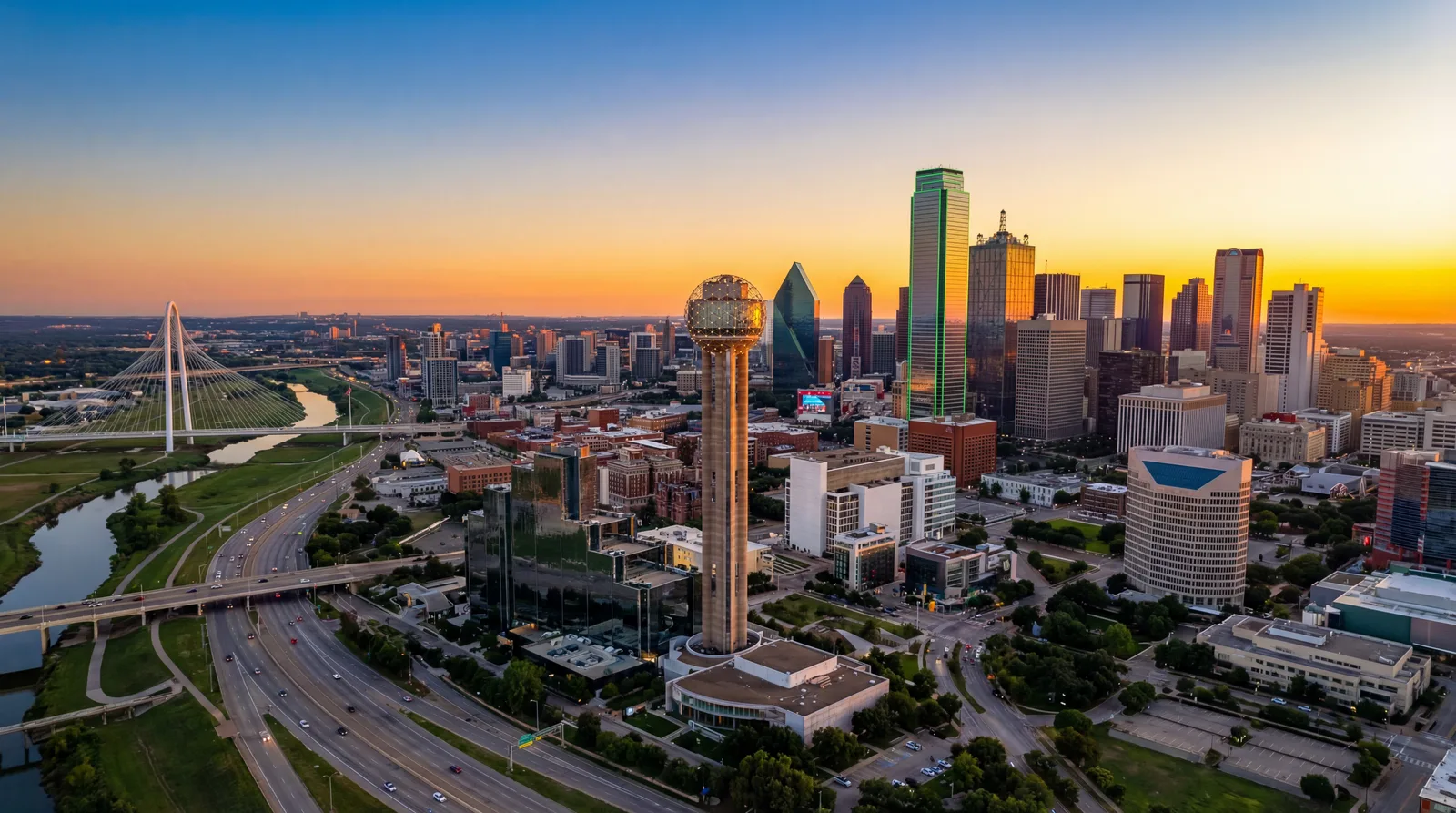 Dallas
 Side-by-Side Metrics
| Category | Houston | Dallas | Winner | Note |
|---|---|---|---|---|
| Median Home Price | $349,769 | $448,703 | Houston | Houston about 22% lower. City median sale prices for both (Redfin, three months to Aug 2026) |
| Average Rent (1BR) | $1,193 | $1,417 | Houston | RentCafe citywide averages, September 2026 |
| Property Tax Rate | ~2.1% | ~2.23% | Houston | Combined, pre-exemption (Harris vs city of Dallas) |
| Metro Population | 7.9M | 8.48M | Tie | Both top-5 US metros; DFW is the larger |
| Fortune 500 HQs | 27 | 24 | Houston | Fortune 500 2026 list: Houston area 27 (Houston 25 + Spring 2), DFW 24 |
| Walk Score (city avg) | 47 | 46 | Tie | Both car-dependent citywide (Walk Score) |
| August Normal High (NOAA 1991-2020) | 94.9°F | 95.8°F | Tie | Houston more humid |
| Annual Rainfall | 51.8 in | 37.0 in | Dallas | Houston gets more rain |
| Airport Options | IAH + HOU | DFW + DAL | Tie | Both have 2 major airports |
| City Population | 2.40M | 1.3M | Houston | Houston is the larger city proper |
| Transit (Light Rail Miles) | METRO, 3 lines | DART 93 mi | Dallas | DART is one of the largest US light rail systems |
| Flood Risk | High | Low | Dallas | Houston faces significant flood exposure |
| Key Industries | Energy/Healthcare/Aerospace | Finance/Tech/Telecom/Defense | Tie | Different strengths in major sectors |
| Diversity Rank | Most diverse U.S. metro (City of Houston) | Diverse | Houston | City of Houston: the most ethnically diverse U.S. metro |
Texas property tax figures above are pre-exemption rates
Texas rates are quoted as combined rates before exemptions — the sum of independently governed taxing units (county, school district, city, hospital, college, and any MUD), so the true total is address-dependent. A Texas homeowner who files for the residence homestead exemption removes $140,000 of taxable value from the school-district portion of the bill only (Tex. Tax Code §11.13(b)). It is not a discount on the whole bill and cannot simply be subtracted from the combined rate.
What it actually saves is $140,000 times your own school district's rate: about $1,230 a year at Houston ISD's tax-year-2025 rate of $0.8783 per $100, and a different amount in every other district (Texas Comptroller — property tax exemptions; Harris County Tax Office 2025 rate table). You must file for it; it is not automatic. Where both cities compared are in Texas, the exemption applies on both sides. Full detail: Texas Property Tax Guide.
Detailed Category Breakdown
Cost of Living
Winner: HoustonHouston is about 22% cheaper than Dallas for housing, with a city median sale price of $349,769 compared to $448,703 in the city of Dallas (city median sale prices, Redfin, three months to Aug 2026). Rental costs follow a similar pattern: Houston's citywide average 1-bedroom rent is $1,193 against $1,417 in Dallas (RentCafe, September 2026). Property taxes are also a little lower: about 2.1% combined for a City of Houston address in Houston ISD (all taxing units, before exemptions; Harris County Tax Office, hctax.net) against about 2.23% for a city of Dallas address. However, Houston homeowners should factor in flood insurance (priced by FEMA zone and the property's Risk Rating 2.0 score), plus MUD (Municipal Utility District) taxes in many suburban developments, which ran from 0.03% to 1.72% of value in Harris County in 2025 (median 0.54%). Groceries, utilities, and transportation costs are comparable between the two cities.
Job Market
Winner: TieHouston leads in energy headquarters (the Greater Houston Partnership's count; ExxonMobil, ConocoPhillips), healthcare (Texas Medical Center, what TMC calls the world's largest medical complex), and aerospace (NASA Johnson Space Center). Port Houston calls the Houston Ship Channel complex the nation's largest port for waterborne tonnage, supporting massive logistics and trade employment. Dallas leads in telecommunications (AT&T), finance (Goldman Sachs, Charles Schwab), technology (Texas Instruments), and defense contracting (Lockheed Martin, Raytheon). The Houston metro hosts 27 Fortune 500 headquarters and Dallas-Fort Worth 24 (2026 list). Houston's economy is more cyclical due to energy sector dependence, while Dallas offers more diversification across finance, tech, and defense. Average salaries are comparable, with Houston slightly higher in engineering and healthcare, and Dallas slightly higher in finance and tech. Both add jobs year over year (BLS).
Weather & Climate
Winner: DallasBoth cities are hot in summer, but Houston's humidity is significantly higher, making outdoor activities uncomfortable from June through September. Houston averages 51.8 inches of rain a year at Bush Intercontinental against 37.0 inches at DFW Airport (NOAA 1991-2020 normals). Dallas experiences more defined seasons, including occasional winter ice storms that can shut down the city for days. Houston sees only a handful of freezing nights in a typical winter. Dallas is in Tornado Alley with higher tornado frequency, while Houston faces hurricane and tropical storm risk from June to November. Dallas is drier and less humid (NOAA normals), though both cities need air conditioning for much of the year.
Transportation
Winner: DallasBoth cities are car-dependent with extensive highway systems. Houston has a light rail system (METRORail) focused on the inner loop. Dallas has DART light rail with over 90 miles of track and broader suburban coverage, making it one of the longest light rail systems in the country (DART's own description). Dallas also has the Trinity Railway Express commuter rail connecting Dallas and Fort Worth. Houston's highway system is more complex, with the notorious I-610 Loop and I-45 corridor. Both cities have two major airports, with Houston offering slightly better international connectivity through IAH's extensive intercontinental routes, especially to Latin America, while DFW International ranks fourth in the world by passengers (ACI World, 2025).
Culture & Lifestyle
Winner: HoustonThe City of Houston calls Greater Houston America's most ethnically diverse metro, which translates into an incredible international food scene — from authentic Vietnamese in Midtown to Nigerian suya in Alief. The Museum District is world-class, and many institutions offer free admission. Dallas has a more polished, corporate culture with upscale shopping (NorthPark Center, Highland Park Village) and a strong sports culture around the Cowboys. Houston's arts scene includes the Theater District and street art across EaDo and downtown. Dallas's Deep Ellum neighborhood rivals Houston's nightlife. Both cities have professional sports teams across all major leagues. Galveston's beaches sit about an hour from Houston; Dallas has no nearby coast but offers lake recreation.
Flooding & Natural Hazards
Winner: DallasHouston faces significant flood risk due to its flat terrain, clay soil, and proximity to the Gulf Coast. Hurricane Harvey in 2017 was devastating, and the city continues to invest billions in flood mitigation infrastructure. A lender requires flood insurance inside a FEMA Special Flood Hazard Area; outside it, flood insurance is optional but worth pricing (FEMA). Dallas's primary natural hazard is tornadoes and severe thunderstorms, but the risk is more seasonal (spring) and localized. Dallas can also experience winter ice storms that disrupt travel. Overall, Dallas has a lower catastrophic weather risk profile.
Schools & Suburbs
Winner: DallasBoth metros have nationally recognized suburban school districts. Houston's Katy ISD, Fort Bend ISD, and Clear Creek ISD feature strong academic programs and diverse student bodies, and Houston suburbs like Sugar Land, The Woodlands, and Pearland deliver family appeal at somewhat lower price points. Dallas-area districts include Plano ISD, Frisco ISD, Southlake Carroll ISD, and Highland Park ISD. DFW suburbs such as McKinney, which added 8,504 residents between July 2024 and July 2025 (U.S. Census Bureau), offer newer infrastructure, master-planned communities, and family-oriented amenities. Both metros provide abundant private school options and proximity to major universities.
Our Verdict
Houston wins on affordability, diversity, and job depth in energy, healthcare, and aerospace. Dallas wins on transit coverage, a drier climate, and lower flood risk. Both offer no state income tax and strong job markets. Choose Houston if you work in energy, healthcare, or want more affordable housing with world-class diversity. Choose Dallas if you prefer a drier climate and better public transit. Your decision should ultimately hinge on your career industry, your tolerance for natural hazards (flooding versus tornadoes), and lifestyle preferences — both cities are excellent choices for Texas relocation with distinct advantages.
Frequently Asked Questions
Is Houston or Dallas cheaper to live in?
Houston is cheaper than Dallas, driven primarily by housing: the city median sale price is $349,769 in Houston vs $448,703 in Dallas (Redfin, three months to Aug 2026), and the citywide average 1-bedroom rent is $1,193 in Houston against $1,417 in Dallas (RentCafe, September 2026). However, flood insurance is worth pricing in Houston, and suburban Houston homes often carry a MUD tax (0.03% to 1.72% of value in Harris County in 2025). Houston comes out ahead on housing cost.
Is Houston or Dallas better for families?
Both cities have excellent suburban school districts. Dallas-area districts like Plano ISD, Frisco ISD, and Southlake Carroll ISD are highly rated nationally. Houston's Katy ISD, Clear Creek ISD, and Fort Bend ISD are equally strong with diverse student populations. Houston offers more affordable family housing, with larger homes available at lower price points. Dallas offers slightly more walkable suburban downtowns and a broader light rail system. Both metros have abundant youth sports, family entertainment, and safe suburban communities. The best choice depends on your industry, budget, and preferred lifestyle.
Which city has better weather: Houston or Dallas?
Dallas has a drier climate with all four seasons, including occasional winter ice storms. Houston has mild winters but extremely humid summers and more rainfall (51.8 inches vs 37.0 inches a year, NOAA 1991-2020 normals). Dallas gets more tornadoes; Houston faces hurricane and tropical storm risk. Dallas is drier and less humid (NOAA normals). However, Houston freezes only a few nights a year, which appeals to those who dislike any cold weather. Summer temperatures are similar (mid to upper 90s), but Houston's humidity makes it feel hotter.
How far apart are Houston and Dallas?
Houston and Dallas are a drive up I-45 or a short flight apart: Southwest lists Hobby to Love Field at 239 miles and 1 hour 7 minutes, and United also flies the route daily. Many companies have offices in both cities, making inter-city transfers common. The Texas Central high-speed rail project has been proposed to connect the two cities, though construction timelines remain uncertain as of 2026.
Which city has a better job market: Houston or Dallas?
Both cities have strong job markets, but they excel in different sectors. Houston is the leader in energy headquarters (Greater Houston Partnership), healthcare (about 106,000 people work at the Texas Medical Center), and aerospace (NASA). Dallas dominates in finance, telecommunications (AT&T headquarters), technology, and corporate operations. Dallas has seen stronger tech job growth in recent years, with companies like Toyota and Charles Schwab relocating headquarters to the area and Goldman Sachs building a major Dallas campus. Houston offers higher average salaries in engineering and medical fields. In August 2026 unemployment was 5.0% in the Houston metro and 4.4% in Dallas-Fort Worth, against 4.3% nationally (BLS, preliminary, not seasonally adjusted).
Which city has better public transportation: Houston or Dallas?
Dallas has significantly better public transit. DART operates 93 miles of light rail covering multiple suburban cities, making it one of the longest light rail systems in the country (DART's own description), and the Trinity Railway Express connects Dallas to Fort Worth. Houston's METRORail runs primarily within the Inner Loop. While both cities are car-dependent, Dallas residents have a much more viable rail commuting option.
Is Houston or Dallas better for tech jobs?
Dallas has a stronger and more diverse tech job market. Major tech employers and headquarters include Texas Instruments and AT&T, plus a growing startup ecosystem in the Telecom Corridor and Deep Ellum areas, and companies like Goldman Sachs and Charles Schwab have brought significant technology operations to DFW. Houston's tech sector is growing but remains more focused on energy technology and healthcare IT. Dallas offers more opportunities across fintech, cybersecurity, SaaS, and telecommunications technology.
Comparing Houston vs Dallas? Try Furnished First.
Houston Corporate Housing offers move-in ready furnished apartments across Greater Houston — perfect for newcomers settling in, corporate relocators, and anyone who needs a comfortable home base while they find their neighborhood.
Sponsored: RelocateMeTX is affiliated with Houston Corporate Housing.
Other Houston Comparisons
Explore Houston
Neighborhoods, schools, jobs & more
Explore Dallas
Full relocation guide
If you add us, Google is more likely to show RelocateMeTX in your Top Stories, and can mark our links as preferred in your AI Overviews and AI Mode. It only affects your own results.