
Is Dallas a good place to live? For most working professionals and families, yes, with real trade-offs. PwC and the Urban Land Institute named DFW the top real estate market to watch for 2026, as CNBC reported in November 2025. And job growth fell 67% that same year. Both things are true. That contradiction tells you more about Dallas than any listicle of pros and cons ever will — it’s a metro of enormous structural advantages held together by trade-offs that most relocation guides conveniently skip. This assessment doesn’t skip them. We’re using 2026 data from the Census Bureau, BLS, Redfin, Zumper, and the Texas Education Agency to give you the honest picture: what’s genuinely great, what’s genuinely hard, and who Dallas is actually right for.
Dallas at a Glance: 2026 by the Numbers
Before the nuance, here’s the raw data. Every number below is sourced and current as of early 2026.
| Metric | Value | Source |
|---|---|---|
| City Population | 1,326,093 | Census ACS 2024 |
| Metro Population (DFW) | 8,344,032 | Census March 2025 |
| Median Household Income | $74,323 | Census ACS 2024 |
| Median Home Sale Price | $448,703 (flat YoY, -0.1%) | Redfin, City of Dallas, Aug 2026 |
| Avg 1BR Rent | $1,355/mo | Zumper April 2026 |
| Cost of Living Index | ~101.7 – 107 | C2ER / BestPlaces |
| Unemployment Rate (DFW, not seasonally adjusted) | 4.7% | BLS Local Area Unemployment Statistics, June 2026 |
| Fortune 500 Headquarters | 21 | Fortune 2025 List |
| Walk Score / Transit Score | 46 / 39 | WalkScore.com April 2026 |
| Property Tax (Combined) | ~2.23% (city; pre-exemption) | County Data 2025 |
| July Avg High | 96°F | NWS |
Two numbers to sit with: the comfortable salary for a single person in Dallas is about $97,000 on SmartAsset’s method (MIT’s living wage doubled), but the city’s median household income is $74,323. That $22,600 gap explains a lot about who thrives here and who struggles. For a deeper breakdown of exactly what that salary covers, see our salary needed to live in Dallas guide.
What the Data Confirms About Dallas
Most relocation guides hit the same bullet points about Dallas. Fair enough. Some of them are genuinely earned. Here’s what holds up under current data.
No State Income Tax — What It Actually Saves You
Texas has no state income tax. For a household earning $100,000, that’s roughly $4,000–$6,000 more per year compared to California or New York. The savings are real, and they compound. But don’t calculate the savings without factoring in property taxes (covered in the cons section), which claw some of it back. Net-net, most transplants from high-tax states still come out ahead.
Job Market: Strong Foundation, but Know the 2025 Story
DFW has 24 companies on the 2026 Fortune 500 list, per CultureMap Dallas. AT&T, Energy Transfer, McKesson, Tenet Healthcare, Kimberly-Clark, and Texas Instruments all call this region home. The job market is genuinely diversified across healthcare, defense, finance, logistics, and enterprise tech. Metro unemployment was 4.7% in June 2026 (BLS Local Area Unemployment Statistics, Dallas-Fort Worth-Arlington, not seasonally adjusted), a touch above the 4.4% U.S. rate on the same basis. The nuance comes in the next section.
Housing Costs Below Major Metros (and Declining)
Dallas’s median home sale price was $448,703 in August 2026 (Redfin, City of Dallas), flat year over year (-0.1%). Compare that to Austin ($549,636) or Denver ($619,090) on the same basis (city median sale price, Redfin, Aug 2026), or any coastal metro and the relative affordability is clear. Average one-bedroom rent runs $1,355/mo (Zumper, April 2026). That won’t impress anyone from Houston, but it’s significantly cheaper than most cities with a comparable job market. For a full neighborhood-by-neighborhood cost breakdown, see our cost of living in Dallas by neighborhood guide.
Sponsored: RelocateMeTX is affiliated with F.A.D Furnished Apartments.
Cultural Diversity and 11,000+ Restaurants
WalletHub ranked Dallas #12 in the U.S. for overall diversity and #7 among large cities in 2026. You’ll feel that range in the food. From the Vietnamese strip malls along Harry Hines to the taco trucks in Oak Cliff to Ethiopian spots in Vickery Meadow, the variety is real and it’s expanding. Dallas proper has over 11,000 restaurants — and the food scene has earned national recognition well beyond steakhouses and Tex-Mex.
Healthcare: UT Southwestern and the Medical Corridor
UT Southwestern Medical Center is consistently ranked among the top 25 hospitals in the country (U.S. News & World Report). Baylor University Medical Center, Parkland Memorial, and Texas Health Resources round out a healthcare corridor that attracts specialists from across the country. If you or your family have ongoing medical needs, Dallas punches well above its weight.
Mild Winters
Winters are short and mild, with average January lows around 37°F, and snow is rare (maybe once or twice a year, and it usually melts by afternoon). For people relocating from the Midwest or Northeast, the first Dallas winter feels like a gift. The trade-off is summer, and we’ll get to that.
Suburban Schools With A Ratings
The city school district (DISD) earned a B rating (85/100) from the Texas Education Agency in 2025-26. Solid, not spectacular. But the suburban ISDs surrounding Dallas are another story entirely. Carroll ISD (Southlake) carries an A rating. Allen ISD earned an A. Frisco ISD rates A, while Plano ISD rates B. Highland Park ISD scored 95/100. If schools drive your decision, the suburbs are where DFW is strongest. Check our Dallas neighborhoods ranked page for school district data by area.
DFW Airport: 4th Busiest in the World
DFW International Airport serves 271 nonstop destinations (DFW Airport, April 2026) and was the fourth-busiest airport worldwide by passenger traffic in 2025, per ACI World. American Airlines runs a major hub here. If you travel for work or want cheap direct flights to almost anywhere, this is a serious quality-of-life advantage that people underrate until they’ve lived with it for a year.
Arts and Sports
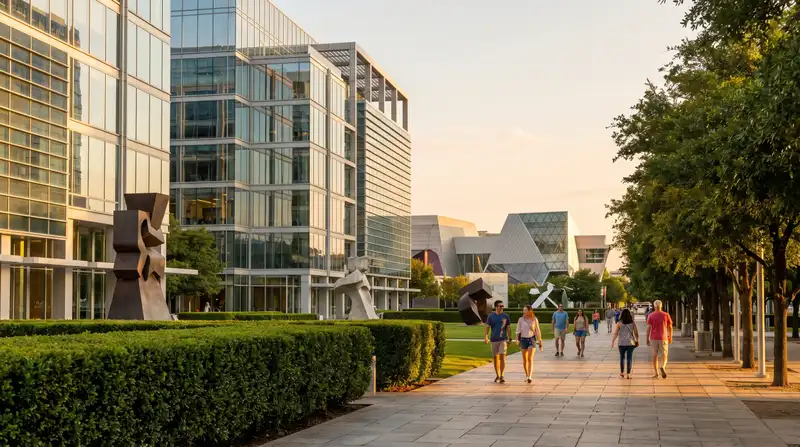
The Dallas Arts District spans 118 acres downtown. The Nasher Sculpture Center, Perot Museum, and AT&T Performing Arts Center anchor it. Sports-wise, you’ve got the Cowboys, Mavericks, Stars, FC Dallas, and the Rangers in Arlington.
Where Dallas Falls Short (and How Much It Costs)
Here’s where most relocation content falls apart. They list “hot summers” and “traffic” as cons and move on. The actual challenges are more specific and more important for your decision.
Summer Heat: 96°F Average, 100°F+ for Weeks
The July average high is 96°F according to the National Weather Service. But averages hide the peaks. Dallas regularly hits 100°F+ for stretches of 7–10 consecutive days in July and August. Your car’s AC runs for the first ten minutes of every drive from May through October. If you’ve never experienced sustained triple-digit heat, you can’t fully prepare for it — you adapt or you leave. Outdoor life effectively pauses from late June through mid-September.
Car Dependency: Walk Score 46, Transit Score 39
Dallas has a Walk Score of 46 and a Transit Score of 39 (WalkScore.com, April 2026). Translation: you need a car. Period. DART’s light rail covers 93 miles across 66 stations, and the new Silver Line (opened October 2025) added a north-south commuter corridor. That helps specific commutes, but it doesn’t change the fundamental geometry of a sprawling metro built around freeways. A few pockets work without a car — Uptown, parts of Deep Ellum, the Knox-Henderson strip — but for most residents, car ownership is non-negotiable.
Property Taxes: ~2.23% Combined (Before Exemptions)
No income tax sounds great until you see the property tax bill. The combined rate runs about 2.23% of value before exemptions in the city of Dallas (stacking city, county, school district, and hospital/college levies) — roughly $9,991 on a $448,703 home (the City of Dallas median sale price, Redfin, August 2026); new-build suburbs with MUD/PID assessments can reach ~3.0%. The good news: Texas passed SB 4 in 2025, raising the school-tax homestead exemption to $140,000, which brings a new owner’s effective rate to about 1.58–1.74% and shaves about $1,391 a year off the bill for owner-occupants in Dallas ISD (2025 rate 0.993835 per $100, Dallas County Tax Office). But even with the exemption, property taxes are the biggest ongoing cost most newcomers underestimate. See our Texas property tax guide for the full breakdown.
Crime: Above Average, but Improving Significantly
Dallas’s violent crime rate sits between 658 and 778 per 100,000 residents depending on the reporting period (FBI 2024 data). That’s above the national average. But the trend matters: Dallas PD reported a 17% drop in property crime and a 2% decline in violent crime year-over-year in 2025. Homicides fell 12% that same year. The city is measurably safer than it was three years ago. Like any major city, safety varies dramatically by neighborhood — our safest Dallas neighborhoods page maps the differences.
Job Growth Slowdown: The 2025 Data Nobody Mentions
This is the stat most Dallas boosters don’t want you to see. DFW added approximately 18,500 jobs in 2025 (BLS), down from 56,100 the year before. A 67% drop. The metro’s unemployment rate was 4.7% in June 2026 (BLS, not seasonally adjusted), so it’s not a crisis — the labor market has loosened, not collapsed. But the days of “Dallas adds 100,000 jobs a year” are, at least temporarily, over. If you’re moving for a specific job offer, you’re fine. If you’re moving hoping to figure it out after you arrive, know that the job market is cooler than the marketing suggests.
The Salary Gap: About $97,000 Comfortable vs. $74,323 Median
SmartAsset’s method (MIT’s Dallas County living wage doubled under a 50/30/20 budget) says a single person needs about $97,000 per year to live “comfortably” in Dallas — covering housing, transportation, food, healthcare, taxes, and modest savings. The city’s actual median household income is $74,323 (Census ACS 2024). That $22,600 gap is real. It doesn’t mean you can’t live on less, but it does mean half the city’s households are financially stretched by local cost standards. Use our cost of living calculator to model your own scenario.
Homeowner Insurance: $4,085–$4,350/Year
Homeowner insurance is expensive here. Expect $4,085 to $4,350 per year on a standard policy (RelocateMeTX data). Hail damage drives the premiums — DFW sits in Hail Alley, and most insurers have repriced after years of multi-billion-dollar claim seasons.
Severe Weather: Hail, Tornadoes, and the Grid
Speaking of hail: DFW averages several significant hail events per year, and tornado warnings are a spring-to-early-summer reality. The February 2021 power grid failure, when Winter Storm Uri knocked out electricity for millions, isn’t forgotten. ERCOT has added reserve capacity since then, but the Texas grid remains independent and carries more risk than interconnected grids in other states. If resilience matters to you, budget for a home generator.
Dallas City vs. DFW Metro: Know the Difference
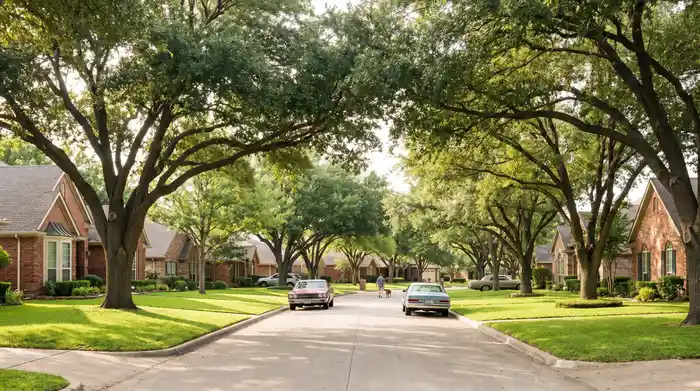
This matters more than most people realize. Dallas city proper (population 1,326,093) has actually seen a slight population decline in the most recent Census estimates. The DFW metro (8,344,032) keeps growing — but the growth is almost entirely in the suburbs. Frisco, McKinney, Celina, and Prosper are absorbing most new residents. Allen, Plano, and Richardson are mature suburbs holding steady.
Why does this distinction matter? Because the city-vs-suburb divide in DFW is stark. Schools, crime rates, property tax rates, walkability, and housing prices differ enormously depending on which side of the line you land on. “Moving to Dallas” could mean a $1,200/mo apartment in Pleasant Grove or a $3,000/mo high-rise in Uptown. Same city. Totally different life.
Dallas for Different Types of Movers
For Young Professionals
Dallas works well if you’re earning $65K+ and willing to live in an urban pocket like Uptown, Deep Ellum, or Knox-Henderson. The job market is corporate-heavy — expect more Fortune 500 interview processes than startup pitch meetings. Nightlife concentrates around Lower Greenville, Deep Ellum, and the Design District. If you’re coming from Austin hoping for the same creative-weird energy, recalibrate. Dallas’s personality leans polished, not bohemian.
For Families with Kids
This is where DFW earns its strongest marks. Suburban school districts like Frisco, Allen, Plano, Carroll (Southlake), and Highland Park carry the A and B ratings listed above. Youth sports infrastructure is extensive. The trade-off is commute time — most of these suburbs sit 25-45 minutes from central Dallas, and that’s without rush-hour traffic doubling it. See our Dallas living guide for family-friendly area breakdowns.
For Remote Workers
No state income tax makes Dallas attractive for remote workers earning California or New York salaries. Coworking spaces have proliferated in Legacy West (Plano), the Design District, and downtown. Internet infrastructure is solid across most of DFW. The downside: if you don’t have office-based colleagues pulling you out of the house, the car-dependent sprawl can feel isolating. Our best Dallas neighborhoods for remote workers guide maps the best WFH areas.
For Retirees
Mild winters and no income tax on retirement income make Dallas appealing on paper. UT Southwestern and the broader medical corridor give you access to excellent healthcare. But the heat, car dependency, and rising property taxes (even with the homestead exemption) can erode quality of life for people on fixed incomes. Dallas isn’t a natural retirement city — it’s built for workers. Retirees who love it tend to already have deep social networks here.
How Dallas Compares to Other Texas Cities
Dallas vs. Austin
Austin offers a smaller, more walkable core, lower crime, and a stronger tech startup ecosystem. Dallas offers more Fortune 500 job diversity (24 vs. 3 in the Austin area), cheaper housing ($449K vs. $550K, city median sale price, Redfin, Aug 2026), and a vastly superior airport. Austin’s median household income is higher ($90,430 vs. $74,323), and its property tax rate is lower (Austin about 2.05% combined, before exemptions, City of Austin + Austin ISD + Travis County + ACC + Central Health, 2025, vs. Dallas ~2.23% combined before exemptions). We break down every metric in our full Dallas vs Austin 2026 comparison.
Dallas vs. Houston
Houston is 4–8% cheaper overall, primarily driven by lower housing costs. Houston’s economy leans energy and medical. Dallas offers cleaner suburbs and more suburban school district variety. Both are car-dependent, sprawling, and hot. For the full numbers, see our Dallas vs Houston cost comparison.
The Best (and Worst) Dallas Neighborhoods for Newcomers
Short version: Uptown and Knox-Henderson suit young professionals. Lake Highlands and Richardson offer families a balance of affordability and school quality. Frisco and Allen are the premium suburban picks. Bishop Arts and Oak Cliff are the up-and-coming areas with character and lower price points.
Neighborhoods to research carefully before committing: South Dallas and parts of Pleasant Grove have lower costs but higher crime rates and fewer amenities. Some new-build communities in far-north suburbs (Celina, Aubrey) come with MUD taxes that can add $2,000–$5,000/year on top of your property tax bill — a surprise nobody warns you about.
For the full ranked breakdown, explore our Dallas neighborhoods ranked guide. And if you’re still early in your research, start with our moving to Dallas guide for a step-by-step relocation walkthrough.

Honest Verdict: Should You Move to Dallas in 2026?
Dallas is right for you if: you’re chasing a corporate career track, want top suburban schools for your kids, travel frequently for work, or you’re relocating from a high-cost state and the tax savings alone justify the move. Families with household incomes above $100K will find DFW’s suburban belt genuinely hard to beat.
Dallas isn’t right for you if: you want a walkable urban lifestyle, you earn under $70K as a single person, you can’t handle five months of serious heat, or you expect the startup/creative energy of Austin or the raw affordability of Houston. Car dependency is the daily reality here, and property taxes will eat into your income-tax savings more than you expect.
The honest answer? Dallas is a great place to build a career and raise a family. It’s a harder place to be young and broke, old and car-dependent, or wired for a walkable, transit-rich life. Know which bucket you fall into, and the decision gets a lot clearer. For a deeper look at the trade-offs, read our pros and cons deep dive.
Frequently Asked Questions
Is Dallas a good city to move to in 2026?
For most working professionals and families, yes. DFW offers a diversified job market with a deep Fortune 500 roster, no state income tax, and a City of Dallas median sale price of $448,703 (Redfin, August 2026), well below Austin ($549,636) or Denver ($619,090) on the same city basis. The caveats: you’ll need a car, property taxes run ~2.23% combined before exemptions (1.58–1.74% effective after homestead), and summer heat is intense. Check the pros and cons sections above to see if the trade-offs work for your situation.
What salary do you need to live comfortably in Dallas?
SmartAsset’s method gives about $97,000/year for a single person to cover housing, transportation, food, and modest savings in Dallas. A dual-income household can be comfortable around $130,000–$150,000. Below $70K as a single earner, you’ll need a roommate or a budget neighborhood like Garland or Mesquite.
Is Dallas safe to live in?
It depends on the neighborhood. Dallas’s overall violent crime rate (658–778 per 100,000) is above the national average, but crime has been declining — down 17% for property crime and 2% for violent crime year-over-year in 2025. Suburban cities like Frisco, Allen, and Southlake have crime rates well below national averages. The safest areas are generally north and northeast of the city center.
Is Dallas expensive compared to other US cities?
Dallas’s cost-of-living index ranges from 100.2 (BestPlaces) to 107 (Salary.com/C2ER), depending on how heavily housing is weighted. That puts it near the national average — cheaper than Austin, Denver, and any coastal metro, but slightly more expensive than Houston and San Antonio. The real variable is property taxes, which can add $10,000+ per year to your housing costs.
What are the worst things about living in Dallas?
The top complaints from actual residents: oppressive summer heat (96°F+ for weeks), total car dependency (Walk Score 46), high property taxes despite no income tax, sprawl that makes everything feel 30 minutes away, and hail damage to vehicles and roofs. The grid vulnerability from Winter Storm Uri still lingers as a concern, though ERCOT has added capacity since 2021.
Is Dallas good for young professionals?
Yes, with conditions. The corporate job market is excellent, especially in finance, healthcare, enterprise tech, and defense. Uptown, Deep Ellum, and Knox-Henderson offer walkable urban living with good nightlife. But entry-level salaries in Dallas often don’t stretch as far as you’d expect — a $55K salary is tight here. Young professionals earning $65K+ in a corporate role will find plenty to like.
Is Dallas a better place to live than Houston?
They’re different trade-offs. Houston is 4–8% cheaper with a stronger energy and medical economy. Dallas has better suburban schools, cleaner suburbs, and a superior airport. Both are hot, sprawling, and car-dependent. Houston adds flood risk. Dallas adds higher property taxes. Neither is objectively “better” — it depends on your career field and whether housing cost or school quality matters more.
How hot does Dallas get in summer?
The July average high is 96°F (NWS), but expect stretches of 100°F+ lasting a week or more. The heat index (factoring humidity) regularly pushes above 105°F in July and August. Summer starts early (late May) and doesn’t break until mid-October. Your electricity bill will spike — budget $200–$350/mo for summer cooling costs.
Does Dallas have good public transportation?
DART operates 93 miles of light rail across 66 stations. The Silver Line commuter rail opened in October 2025, adding north-south coverage. But for most residents, transit doesn’t replace a car. Dallas’s Transit Score is 39 out of 100. Pockets like downtown and Uptown work without a car; everywhere else doesn’t.
Is Dallas growing or shrinking?
The DFW metro (8,344,032 people) continues growing. But Dallas city proper (1,326,093) has seen a slight population decline in recent Census estimates. The growth is suburban: Frisco, McKinney, Celina, and Prosper are absorbing most new residents. If you’re asking “is Dallas popular?” — absolutely. The growth just isn’t happening inside city limits.