
Dallas property taxes come to about 2.23% of a home’s value before exemptions inside the city of Dallas (the sum of all taxing entities), and 1.58% to 1.74% for a new owner who files the homestead exemption. You moved to Texas for no state income tax. Then your first property tax bill arrived.
It’s a common financial shock for Dallas newcomers. On a $500,000 home, that effective rate is $8,300 to $8,700 per year added to your housing costs. Texas ranks as the 7th-highest property tax state in the country. Nobody puts that in the “move to Texas” headlines.
This guide breaks down the full property tax system for people who have never dealt with it. Not for existing homeowners trying to protest. For you, the person about to move here, who needs to understand what you’re walking into before you sign anything.
On a $500K home: ~$8,300-$8,700/year ($690-$725/month added to mortgage)
Homestead exemption: Up to $140,000 off school district taxable value
MUD/PID in new suburbs: $200-$400/month additional on top of regular taxes
National ranking: Texas is the 7th-highest property tax state in the U.S.
Still deciding on Dallas? Our complete Moving to Dallas guide covers 22 topics including neighborhoods, salary math, and a moving checklist.
The Trade-Off Nobody Explains Before You Move
Texas collects zero state income tax. On a $100,000 salary, that saves roughly $5,000 to $8,000 per year compared to California (9.3-13.3% top rate) or New York (10.9%). That sounds like a windfall. But Texas funds its government through property taxes instead. The city of Dallas combined rate is about 2.23% before exemptions; even the after-homestead effective rate of 1.58 to 1.74% runs well above the national average of 0.92% (PropertyTaxByState.com).
The math doesn’t always work in your favor. Whether you come out ahead depends on two variables: your income and your home price.
| Scenario | Income Tax Saved (vs. CA) | Dallas Property Tax | Net Savings |
|---|---|---|---|
| $100K salary, $300K home | ~$6,000 | ~$5,000-$5,200 | +$800-$1,000/yr |
| $100K salary, $500K home | ~$6,000 | ~$8,300-$8,700 | -$2,300-$2,700/yr |
| $150K salary, $400K home | ~$10,000 | ~$6,600-$7,000 | +$3,000-$3,400/yr |
| $150K salary, $600K home | ~$10,000 | ~$10,000-$10,400 | -$0-$400/yr (break-even) |
| $200K salary, $500K home | ~$15,000 | ~$8,300-$8,700 | +$6,300-$6,700/yr |
The pattern is clear: higher income plus a lower-priced home equals a win in Texas. A $100K earner buying a $500K home actually pays more in combined taxes than they would in California. A $200K earner buying that same home keeps $6,300 to $6,700 per year. Your salary and your purchase price determine which side of the equation you land on.
For the full salary math, see our Dallas salary breakdown. For the broader pros and cons of moving to Dallas, that post covers property taxes as one of the top 8 downsides.
RelocateMeTX is affiliated with F.A.D Furnished Apartments.
California's Prop 13 caps your property tax increase at 2% per year, no matter how much your home appreciates. Texas's cap is looser. Once your home carries a homestead exemption, its appraised value can still rise up to 10% a year, and the cap only takes effect on January 1 of the year after you qualify, per the Texas Comptroller. If your Dallas home's market value jumps 15% in your first year, your taxable value can follow it. Long-term California homeowners often pay far less in property taxes than Texans with comparable home values. Budget for rising taxes every year, not a fixed number.
How the Tax Bill Actually Works
Your bill is collected by multiple overlapping government entities, each setting its own rate independently. Your total bill is the sum of all of them. Understanding this structure explains why two homes at the same price in different parts of DFW can have wildly different tax bills.
The Appraisal
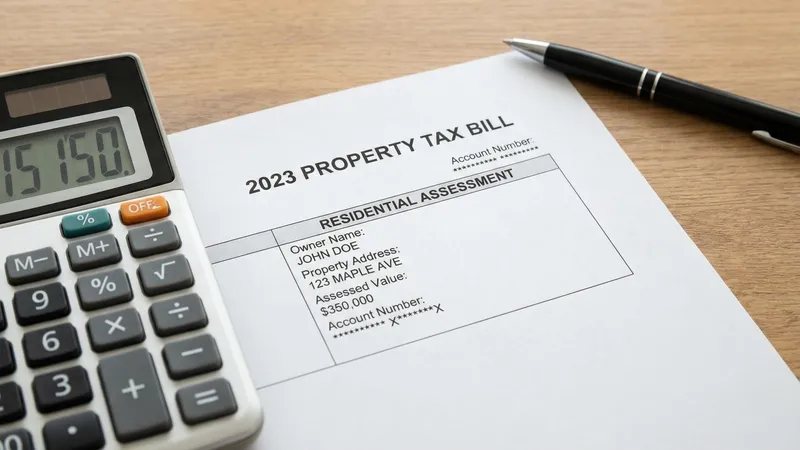
Every January 1, the Dallas Central Appraisal District (DCAD) assesses the market value of your home. Around April 15, they mail a Notice of Appraised Value. This number is what your taxes are calculated on. If you believe the appraisal is too high, you have the right to protest (covered below).
The Taxing Entities
Your property tax bill is not one tax. It is multiple taxes stacked together:
- County (Dallas County): ~$0.22 per $100 of assessed value
- City (City of Dallas, or your specific city): varies by municipality
- School district: the largest single chunk, often 40-50% of your total bill
- Special districts: hospital district, community college district, water district, and others
Each entity votes on its own rate every year. Your total bill is the sum of all applicable rates multiplied by your assessed value. This is why two $500K homes, one in Richardson (Richardson ISD) and one in Garland (Garland ISD), pay different property tax amounts despite being in the same county.
The Four-County Reality
DFW spans four major counties. Where you buy determines your rate.
| County | Combined Rate (pre-exemption) | Median Annual Tax | Key Cities |
|---|---|---|---|
| Dallas County | ~2.23% | ~$4,798 | Dallas, Irving, Richardson, Garland, Mesquite |
| Collin County | ~2.19% | ~$6,800+ | Plano, Frisco, McKinney, Allen, Prosper |
| Denton County | ~2.05% | ~$5,500+ | Denton, Flower Mound, Lewisville, parts of Frisco |
| Tarrant County | ~2.37% | ~$5,200+ | Fort Worth, Arlington, Southlake |
Collin County’s 2.19% rate means a $500,000 home there costs roughly $10,950 per year in property taxes, roughly $200 less than the same home in the city of Dallas. Check the Dallas Neighborhoods Guide for a full breakdown of which suburbs fall in which county.
The Homestead Exemption: File This Immediately
The homestead exemption reduces the taxable value of your primary residence by up to $140,000 for school district taxes, which in Dallas ISD is worth about $1,391 a year whatever the home’s value (the exemption is a fixed $140,000 at the TY2025 school rate of 0.993835%). It is not automatic. You must file it yourself with the Dallas Central Appraisal District before April 30 of the tax year.
How it works: As of November 2025, Senate Bill 4 raised the school district homestead exemption to $140,000. On a $500,000 home, your school district taxes are calculated on $360,000 instead of $500,000.
Deadline: April 30 of the tax year. Late filing is possible (up to two years back), but you may miss a full year of savings.
How to file: Online at dallascad.org, by mail, or in person at the DCAD office (2949 N. Stemmons Freeway, Dallas).
What you need: Proof of ownership (deed or closing documents), a Texas driver’s license or state ID showing the property address, and the completed exemption application form. If your ID still shows your old state address, update it at the DPS before filing.
For more on how property taxes fit into your total housing budget, see the Dallas housing overview.
Additional Exemptions
Over-65: An additional $60,000 off school district taxes (raised from $10,000 by Proposition 11, voter-approved November 2025), plus a school district tax freeze. Your school taxes cannot increase above the amount in the year you turned 65 or claimed the exemption. Cities and counties may offer their own additional exemptions.
Disabled: Same additional exemption and tax freeze as over-65.
100% Disabled Veterans: Total property tax exemption on your homestead. Zero dollars owed. On a $500,000 home, that saves $8,300 to $8,700 per year.
Surviving spouse of disabled veteran: May continue the exemption under certain conditions. Contact Dallas County Tax Office for eligibility details.
MUD and PID Taxes: The Hidden Layer in New Suburbs
Municipal Utility Districts (MUDs) and Public Improvement Districts (PIDs) add $200 to $400 per month on top of regular property taxes in new DFW suburbs like Frisco, Prosper, Celina, and Forney. These special assessments fund infrastructure that the city hasn’t built yet, and many buyers don’t discover them until closing.
MUD (Municipal Utility District) is a special taxing district that funds water, sewer, drainage, and road infrastructure in new developments. The developer creates the MUD, builds the infrastructure, and residents pay it back through a special tax assessment that typically runs 20 to 30 years.
PID (Public Improvement District) funds specific improvements: landscaping, amenities, security, parks within a development. Similar concept, different scope.
Both are additional taxes on top of your regular property taxes and HOA fees. The cost: $200 to $400 per month. Some MUD districts add another 0.5 to 1.5% to your effective property tax rate.
The trap: many buyers don’t discover MUD/PID costs until closing, when the title company discloses them. By that point, you’re emotionally and financially committed. Always ask “Is this property in a MUD or PID?” before making an offer. Request the full amortization schedule so you know when the bonds retire.
A $450,000 home in a Frisco MUD district can have a total monthly housing payment (mortgage + property tax + MUD + HOA + insurance) that is $500 to $800 MORE per month than the same-priced home in an established Dallas neighborhood without MUD/PID. Run the full numbers before you compare. The listing price alone tells you nothing.
How to Protest Your Property Tax Appraisal
Dallas County property tax protests succeed roughly 60 to 70% of the time, according to Texas Comptroller data. On a $500,000 home, even a modest 5 to 10% appraisal reduction saves $400 to $850 per year. Most Dallas homeowners protest annually, and the data supports making it a habit.
Deadline: May 15, or 30 days after your appraisal notice is mailed, whichever is later.
How to file: Submit a protest with DCAD online at dallascad.org, by mail, or in person.
What to bring: Comparable sales data (recent sales of similar homes within a half-mile), photos of any condition issues that reduce value, and an independent appraisal if you have one. Redfin and Zillow comps work for gathering comparable sales.
DIY or hire a firm: Many homeowners hire property tax protest firms like Ownwell, NTPTS, or O’Connor & Associates. These firms work on contingency: they only charge if they save you money. Typical fee is 25 to 40% of the first-year savings. On a $500K home where they achieve a 10% reduction, you’d save about $850 and pay roughly $250 to $340 in fees. Net positive from year one.
Is it worth it? Over five years in the home, even a modest 5 to 10% reduction saves $2,000 to $4,250. Property taxes in Dallas County have risen 32.7% since 2019 (Ownwell), so annual protests are a reasonable habit.
How Dallas Compares to Where You’re Coming From
A new Dallas owner’s effective property tax rate of 1.58 to 1.74% (what you pay after the homestead exemption) lands well above California (0.71%), Florida (0.80%), and Colorado (0.55%), but below Illinois (2.07%). Your experience depends on which state you’re leaving and whether income tax savings offset the higher property tax bill.
| State | Effective Rate | Annual Cap on Increases | On a $500K Home |
|---|---|---|---|
| Texas (Dallas County) | 1.58-1.74% | No cap (10% homestead cap on appraised value, not rate) | $8,300-$8,700/yr |
| California | 0.71% | 2%/year (Prop 13) | ~$3,550/yr |
| New York | 1.40% | Varies by jurisdiction | ~$7,000/yr |
| Illinois (Cook County) | 2.07% | No cap | ~$10,350/yr |
| Florida | 0.80% | 3%/year (Save Our Homes) | ~$4,000/yr |
| Colorado | 0.55% | Varies (TABOR limits) | ~$2,750/yr |
If you’re coming from California, New York, or Florida, your Dallas property tax bill will be significantly higher, potentially double or triple what you paid before. If you’re coming from Illinois or New Jersey, Dallas may actually be cheaper. The “no income tax” savings offset property taxes more effectively at higher income levels. A $200K household income with a $400K home comes out well ahead. A $80K household income with a $500K home does not.
State-level data from the U.S. Census Bureau confirms that Texas homeowners pay a higher share of home value in property taxes than 43 other states. For state-by-state moving guidance, see our California to Texas moving guide and the Texas property tax overview. If you need help estimating your salary adjustment, our Dallas employers page covers the major job markets by industry.
File Your Exemption, Run the Math, Then Decide
Property taxes are the trade-off for zero state income tax. Whether that trade-off works in your favor depends on your income, your home price, and whether you file the exemptions and protests available to you. At $150K+ household income with a home under $450K, the math clearly favors Texas. At lower incomes with higher-priced homes, it gets tighter.
Three actions before you buy: file your homestead exemption the month you close, ask about MUD/PID on every new-construction property, and plan to protest your appraisal every May. Those three steps can save $3,000 to $5,000 per year.
Start with our complete Moving to Dallas guide for the full picture, or jump to the Dallas moving checklist if you’re ready to go. For everything else about what living in Dallas is like — from the pros and cons to the best neighborhoods, cost of living breakdown, and job market — the living in Dallas guide has the full overview.
Frequently Asked Questions
How much are property taxes on a $400,000 home in Dallas?
The city of Dallas combined rate is about 2.23% before exemptions (~$8,900 on a $400,000 home). After you file the homestead exemption, a new owner’s effective rate is about 1.58 to 1.74%, so a $400,000 home costs roughly $6,320 to $6,960 per year, or $527 to $580 per month added to your mortgage. In Collin County (Frisco, Plano), combined rates run higher (about 2.19%), so the same home costs more.
Do I have to pay property taxes if I rent in Dallas?
Not directly, but they are factored into your rent. Landlords pass property tax costs through to tenants. When Dallas County property taxes rise, rents tend to follow within 6 to 12 months. This is why even renters should pay attention to property tax rates when choosing where to live in DFW.
When are Dallas property taxes due?
Property taxes are assessed on January 1 and due by January 31 of the following year. For example, 2025 taxes are due by January 31, 2026. Unpaid taxes begin accruing interest on February 1. If you have a mortgage, your lender typically collects property taxes monthly through an escrow account. The Texas Comptroller publishes the full calendar and penalty schedule.
Can I protest my property taxes every year?
Yes, and many Dallas homeowners do. The deadline is May 15 or 30 days after your appraisal notice, whichever is later. File yourself with DCAD or hire a firm on contingency. About 60 to 70% of protests result in a reduction. Even a 5 to 10% reduction on a $500K home saves $400 to $850 per year.
What is the difference between property tax rate and effective rate?
The “rate” is the official rate set by each taxing entity (county, city, school district, special districts) per $100 of assessed value. The “effective rate” accounts for exemptions and the taxes actually paid relative to home values. The city of Dallas combined nominal rate adds up to roughly 2.23% before exemptions; the effective rate after the homestead exemption — what a new owner actually pays — is 1.58 to 1.74%. Budget with both: the combined rate for year one, the effective rate ongoing.
Do I have to pay property taxes my first year in Dallas?
Yes, but the math depends on when you closed. Texas property taxes are assessed January 1 each year. If you bought a home in June, the seller typically pays a prorated share through your closing date and you pick up the rest of the year. At closing the seller’s prorated taxes are credited to you, and by January 31 of the following year you (or your mortgage escrow) pay the full annual bill. New construction sometimes triggers a partial first-year bill if the home wasn’t on the tax roll January 1, then a much larger second-year bill once the finished value lands. Budget for this — newcomers are often surprised by the year-two jump.
How does the Texas homestead exemption work?
The homestead exemption removes a portion of your home’s appraised value from school district taxation. As of 2025 (Senate Bill 4), the school exemption is $140,000 — up from $100,000 the prior year. On a $400,000 home, school taxes are calculated on $260,000 of taxable value instead of $400,000. Counties, cities, and special districts have their own smaller exemptions (typically $5,000 to $25,000). The home must be your primary residence as of January 1 of the tax year. Seniors (65+) and disabled homeowners get an additional $60,000 school exemption ($200,000 total). The exemption locks in school tax-bill increases at no more than 10% per year while you remain in the home.
What is the deadline to file the Dallas homestead exemption?
April 30 of the year following your home purchase. File once with the Dallas Central Appraisal District (DCAD) for Dallas County, with Collin Central Appraisal District for Collin County (Frisco, Plano), or with the appropriate county appraisal district for your address. The exemption renews automatically each year — you only file once, unless you sell and buy a new primary residence. Late filing is allowed up to two years after the deadline, and DCAD will reimburse overpaid taxes. Don’t skip this — on a $400K home, the homestead exemption saves about $1,391 a year in Dallas ISD school taxes alone ($140,000 at the TY2025 rate of 0.993835%).